PM Nabbanja applauds UBOS for undertaking a timely Census dissemination report
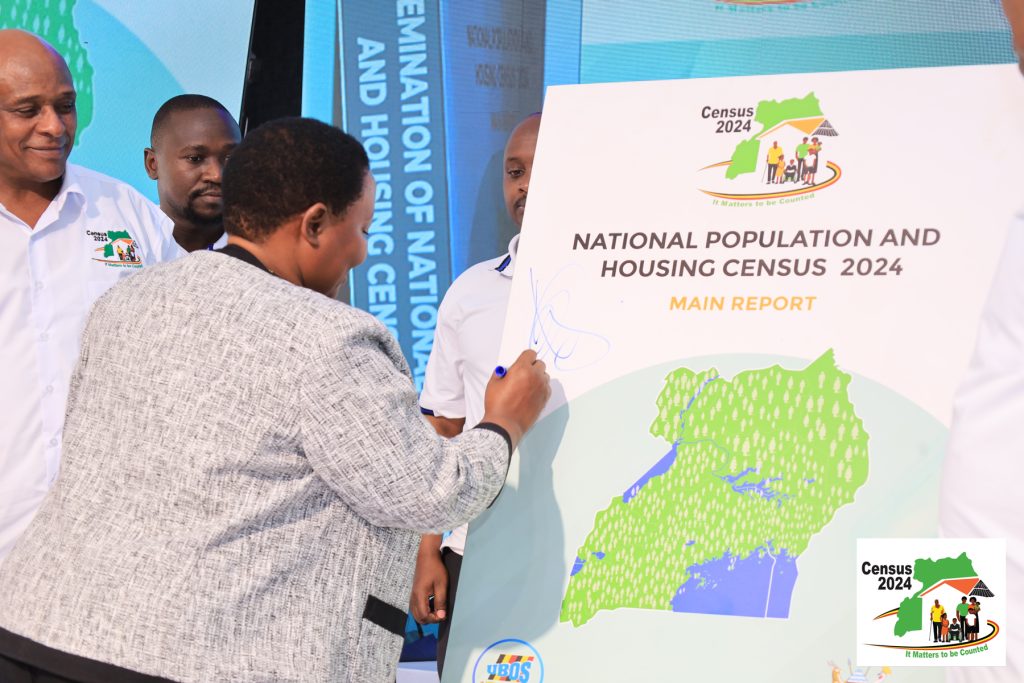
(L-R) Prime Minister Rt. Hon. Robinah Nabbanja together with Hon. Amon Lugoloobi the State Minister for Finance incharge of planning during the census dissemination report launch
By Evans Najuna
KAMPALA – Uganda’s Prime minister Rt. Hon. Robinah Nabbanja, who doubles as the leader of Government business in parliament has applauded the Uganda Bureau of statistics (UBOS) for undertaking a timely Census dissemination report. Nabbanja made these remarks on Thursday while launching the 2024 Uganda National population and housing census dissemination report (NPHC2024) at Serena hotel in Kampala.
According to Nabbanja, it was on 12th December 2023 when President Museveni launched the Census roadmap at Kololo Independence Grounds and he reminded all citizens and rallied the entire country of the importance of census data in answering the key five (5) key questions that are people-centric on; how many Ugandans there are, where they live, how they live, what they own and how they access key government services.
She added that, the fountain of honour emphasised that by answering the above questions, the census data mirrors a report card on the performance of the political class in fulfilling the fundamental objective of transforming every Ugandan from peasantry practices into a modern commercial economy.

The prime minister noted that, while on the same venue at Serena hotel, on 27th June 2024, the President officially received the Census 2024 preliminary results which mainly answered the first two (02) of the five (05) questions i.e How many Ugandans we are and partly how live.
“We have been informed, that on the same occasion in June, the Census Commissioner made a public promise that the 2024 Census final report would be ready by the end of September 2024,” Nabbanja added.
She then expressed her gratitude and a vote of thanks to UBOS on behalf of the government and all Ugandans for the great work as per the promise by the UBOS Executive Director who is also Census Commissioner.
“The nation is witnessing the release of the final report for the National Population and Housing Census 2024 that answers in entirety, all the five key questions and all other comprehensive indicators highlighted in the presentation,” the Prime minister expressed.
Additionally, Rt. Hon. Nabbanja also applauded the all different committees and stakeholders who participated in the technical preparations for the census programme as already outlined by the UBOS Board Chairman, and particularly the leadership at the Uganda Bureau of Statistics for a job well done.

“Thank you for the results. I also wish to thank all Ugandans for embracing and participating in all the stages of the Census through which we were able to collect quality data,” she added.
Nabbanja further narrated that, the revelations that come with census results are core in giving direction to the country. The country will be able to reflect on what it has been doing, how it has been doing it and with precision, determine the next course of action.
“For instance, we see from the results, the population of Uganda stands at 45.9 million persons and includes more than a million refugees,” she said. Adding that this is an increase by 10 million persons from the 2014 Census when the population stood at 34.6 million persons.
Undeniably, this increase in population could likely be an outcome of the government’s priorities in the health sector over the years mainly on immunization and roll out of Health Centre IVs, IIIs and IIs at various levels. Further analysis of this information will give us a clear picture of the national and zonal per capita income detailing the citizenry standard of living and the quality of life they lead, the prime minister explained.
In so doing, government will be able to overcome one of the most intriguing challenges of transforming every Ugandan household into the money economy. Most significantly, going forward, all government functionaries should utilize this data to re-modal the operations of the Parish Development Model to ensure that “Omuntu wa Wansi” benefits as it is the prime target of government.
She implore all stakeholders and the country to study further all the Census 2024 final report’s demographic and social indicators such as life expectancy, fertility rate, mortality rates, education attainment levels, household welfare among others, to ensure that the people are well sensitized on the importance of embracing government programmes in the quest for a better life. The NRM government is here to ensure that every Ugandan appreciates the transformation gospel… and together, we can all do it!
“As a the leader of government business, I am in particular, interested in understanding the implication of all these economic and demographic indicators that use the population as a denominator and how these reflect on our Sustainable Development Goals (SDGs) reporting and how we can humanize the local reporting of these indicators for easy understanding by the population.”
She highlighted out that as earlier, with the results, what does the per capita income translate to? What does the immunization coverage translate into? Of course, there are other implications of interest that call for closer analysis. For instance, how can we harness the demographic dividend to ensure that the increase in population translates into market advantage for our locally produced goods and services?
Therefore, I implore all stakeholders to receive and interrogate these statistics with the view to improving the planning and service delivery in your respective sectors and for the benefit of the population.
Conclusively, Nabbanja also implore UBOS to ensure that this report is widely disseminated at all levels for wider usage and appreciation. She then declared the Census 2024 final report officially received by Government.
KEY HIGHLIGHTS
74% of the population are literate. The fertility rate is 4.5% and life expectancy at birth is 68.5 years. The unemployment rate is 12.6%.
In the line of Religious affiliation, Christians form the biggest portion of the population. 8 out of 10 Ugandans are Christians. Catholics form the larger percentage at 37.4% followed by Anglicans at 30.0%. Pentecostals have increased to 14.7% from 11.1%.
Children between 0-17 years form the largest part of the population standing at 50% followed by the youth between 18-30 years at 23.5% while older persons make 5% of the total population. Total number of Households in Uganda totals to 10,698,913.
The Total population for Uganda as of May 2024 based n the National Population and Housing Census 2024 stands at 45,905,417 persons with the Male population recorded at 21,566,736 while the Female is recorded at 24,338,681 persons. The growth rate is recorded at 2.9.
About Post Author