BILLIONS IN THE DARK! Energy Ministry on Spot Over ‘Missing’ Sh17.3Bn for 32,000 PAP’s, Mystery Sh33Bn Loan, Sh128Bn Receivables, Sh80Bn Arrears, Uninstalled Weighbridges Illegal Mineral Dealers, 245 Rogue Fuel Stations & Botched Power Connections

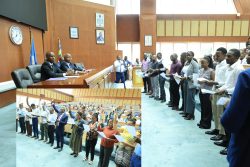
KAMPALA: The Ministry of Energy and Mineral Development came under intense scrutiny on Friday after Parliament’s Public Accounts Committee (PAC) questioned glaring inconsistencies in the accounting for Shs17.3 billion in government counterpart funding under the Uganda Rural Electrification Access Project (UREAP), with officials struggling to explain conflicting figures on compensation payments, project accounts and ministry records.
The heated hearing, chaired by Kassanda North MP Patrick Nsamba Oshabe, examined the Auditor General’s report for the financial year ending June 30, 2025, as senior ministry officials attempted to reconcile differences between the Auditor General’s findings, the project’s financial statements and the ministry’s own submissions on how the funds were utilised.
At the centre of the controversy was government counterpart funding under the African Development Bank-supported Uganda Rural Electrification Access Project, a flagship programme intended to expand electricity access across the country.
According to the Auditor General, government approved compensation worth about Shs34 billion for Project Affected Persons (PAPs). However, by the time of the audit, only approximately Shs14.6 billion, representing about 40 percent of the approved compensation, had actually been paid.
Ministry officials told the committee that the government counterpart funding was primarily intended to compensate landowners affected by electricity infrastructure works, while a small portion financed biodiversity restoration activities, including tree planting.
However, committee members immediately pointed to the project’s financial statements, which indicated that the entire Shs17.3 billion allocated by government had already been spent, despite records showing that only Shs14.6 billion had actually reached the Project Affected Persons during the audit period.
The contradiction immediately raised red flags.
“Money cannot simply appear without a purpose,” Oshabe told ministry officials, insisting that every shilling appropriated by Parliament must be fully accounted for.
As pressure mounted, ministry officials altered their explanation, saying part of the counterpart funding had also financed operational activities related to compensation, including property valuation, field verification and facilitation of compensation teams.
The explanation failed to convince the committee.
“You told us 99 percent of this funding was meant for compensation. Now you are changing the story,” Oshabe said.
The hearing became even more explosive after ministry officials disclosed that the African Development Bank had authorised the use of an additional Shs13.48 billion from uncommitted loan funds to finance compensation after government delayed releasing part of its counterpart contribution.
Committee members observed that when the government counterpart funding and the additional donor financing were combined, nearly Shs30 billion had been available for compensation.
Yet the Auditor General’s report still showed that only Shs14.6 billion had actually reached the Project Affected Persons during the audit period.
“Something is not adding up,” Oshabe observed. “You have government funds, donor funds, yet only a fraction reached the Project Affected Persons.”
Eng. Irene Pauline Bateebe maintained that the Auditor General’s report reflected the project’s financial position as of June 30, 2025, and argued that additional compensation payments had been made before the project officially closed on March 31, 2026.
The committee, however, questioned why the ministry’s written responses submitted to Parliament still reflected the earlier figures instead of updated project accounts.
The hearing took another dramatic turn when ministry officials revealed that about 32,000 Project Affected Persons remained uncompensated even after the project’s completion.
Officials further disclosed that government has since sought an additional Shs33 billion loan to settle the outstanding compensation claims.
That revelation triggered another round of tough questions.
“Government committed itself to finance this component. Why are you borrowing again instead of meeting your own obligation?” Oshabe asked.
Committee members also questioned how the number of Project Affected Persons increased from an estimated 37,000 to more than 61,000 during project implementation, saying the sharp increase raised concerns about project planning, valuation and compliance with environmental and social safeguards.
Throughout the hearing, Oshabe reminded accounting officers that Parliament’s oversight powers extend beyond issues specifically identified by the Auditor General.
“Parliament is not limited to questions raised by the Auditor General. We are entitled to ask how public money was spent,” he said.
He also criticised ministry officials for appearing before the committee without detailed expenditure schedules despite managing a project worth more than Shs453 billion.
Committee members further questioned why senior project managers were unable to clearly explain how grant funds were allocated for the procurement of electricity meters, cables and connection materials.
The compensation dispute also raises broader questions about compliance with environmental and social safeguards governing infrastructure projects financed by multilateral lenders such as the African Development Bank, where timely compensation of affected communities is a key requirement before project implementation begins.
The committee directed the Ministry to submit a comprehensive reconciliation detailing the utilisation of the Shs17.3 billion government counterpart funding, the actual compensation paid to Project Affected Persons, operational expenditures charged against the counterpart funds, biodiversity restoration costs and the justification for seeking an additional Shs33 billion loan after the project’s closure.
The grilling follows a string of damaging findings contained in the Auditor General’s report on the Uganda Rural Electrification Access Project.
The audit found that by June 30, 2025, total cumulative donor disbursements had reached 95 percent, while Government of Uganda counterpart funding stood at only 50 percent.
Although the project achieved 100 percent completion of Medium and Low Voltage infrastructure across 13 lots, only 98,584 of the planned 141,451 electricity customer connections had been completed, representing only 69 percent implementation.
The Auditor General further reported that the project had Shs29.49 billion available during the year under review but spent only Shs15.59 billion, translating into an absorption rate of just 53 percent.
The report also confirmed that out of 37,501 Project Affected Persons approved by the Chief Government Valuer, only 15,096 (40 percent) had been compensated by the end of the 2024/2025 financial year, largely because of underperformance in government counterpart funding.
The wider audit of the Ministry of Energy and Mineral Development painted an equally troubling picture.
The Auditor General reported that the ministry had long outstanding receivables amounting to Shs128 billion, some dating back to the 2021/2022 financial year.
The ministry’s domestic arrears had exploded by more than 1,000 percent, rising from Shs7.14 billion to Shs80.11 billion, largely due to historical rural electrification liabilities that had previously not been recognised in the financial statements.
Auditors also noted that the ministry had reported mineral resources worth Shs35.57 trillion, although the estimates were based on geological information dating back to the 1920s, with validation still ongoing.
The report further uncovered several procurement irregularities, including failure to prepare multi-year procurement plans, non-compliance with reservation schemes, failure to conduct market assessments and splitting procurements.
In the mining sector, auditors found delays in converting 10 mining licences, while eight mineral rights applicants were granted licences without undergoing adequate evaluation. Another 114 licence applications took more than 100 days to be processed.
The report also found that 17 traders were buying and selling minerals without mineral rights or valid mineral dealer’s licences, while 14 exploration licence holders were carrying out mining operations beyond the activities permitted under their licences.
Auditors further established that weighbridges and related accessories, procured and delivered in November and December 2021, had still not been installed by October 2025, representing a delay of almost four years.
The report further criticised the ministry for lacking a recognised national reporting code for mineral resources, an accredited registry of competent persons and a standardised framework for reporting mineral resources.
Auditors also identified weaknesses in the management of ministry assets, including under-utilised facilities, non-functional beneficiation centres, lack of documented monitoring procedures and untitled government land.
Financially, the ministry received only Shs724.33 billion out of an approved budget of Shs1.176 trillion, representing 62 percent budget performance, although it spent 99.3 percent of the funds released.
Performance was equally poor.
Out of 23 sampled outputs, 19 (83 percent) were only partially implemented, one output (4 percent) was not implemented at all, while three outputs (13 percent) could not even be assessed because they lacked planned activities, performance targets or measurable indicators.
The Auditor General also found that under the Rural Electrification and Connectivity Project, several engineering, procurement and construction (EPC) works were reported as completed even though Resettlement Action Plan (RAP) implementation remained below 100 percent.
The report further revealed that petroleum facilities continued receiving completion certificates and operating licences despite being incomplete and operating below minimum standards, while 245 petroleum facilities were operating without valid operating licences or construction permits.
Finally, although the ministry had already reduced its electricity connection target from the national requirement of 300,000 to 226,890 because of funding gaps, only 39,701 electricity connections (17.5 percent) had actually been completed, leaving 187,189 planned connections unfinished.
GOT A HOT STORY? LET US KNOW!
Got breaking news, explosive secrets, or hard evidence?
Email us: redpeppertips@gmail.com
We accept tips, documents, videos, photos, and recordings—the more evidence you have, the better.
CONFIDENTIALITY IS OUR TOP PRIORITY. SOURCES ARE ALWAYS PROTECTED!
About Post Author