BOU-SACCO LICENSING STAND-OFF! Speaker Oboth Comes to Rescue of SACCOs

KAMPALA — Speaker of Parliament Rt. Hon. Jacob Marksons Oboth has stepped into the escalating stand-off between the Bank of Uganda (BoU) and the country’s large Savings and Credit Cooperative Organisations (SACCOs), securing a phased compliance roadmap and pushing for changes to the law governing the sector.
The breakthrough followed a tense two-hour meeting in Parliament’s South Committee Room involving BoU, the Uganda Co-operative Savings and Credit Union (UCSCU), and officials from the Ministries of Finance and Trade.
The meeting was convened after UCSCU petitioned the Speaker over a BoU directive requiring large SACCOs to apply for licences by September 30, 2026, failure to which they risk being cut off from the commercial banking system.
Under the directive, SACCOs without the required BoU licence from October 1 could lose access to deposits held in commercial banks and be unable to conduct transactions through mobile money channels.
The looming deadline had sparked concern among SACCO leaders, who warned that a sudden financial-system cut-off could disrupt millions of members and trigger panic within the sector.
Lt. Gen. Sam Kavuma, a board chairman and Wazalendo SACCO leader, described the situation as a potential crisis, warning that the measures could expose SACCOs to ruins.

However, BoU Governor Michael Atingi-Ego maintained that the central bank was simply enforcing existing law.
Atingi-Ego told the meeting that BoU’s regulatory mandate is anchored in the Microfinance Deposit-Taking Institutions Act, Cap. 58, and the Micro-Finance Deposit-Taking Institutions (Registered Societies) Regulations, 2023.
The Governor said BoU had already honoured commitments made during a February 2026 stakeholders’ meeting, including extending the original deadline, receiving a matrix of regulatory gaps from the cooperative movement and conducting sensitisation engagements.
“We have done all those three religiously,” Atingi-Ego told the Speaker.
According to the Governor, eight SACCOs are already fully licensed, 21 are at the final stage of licensing, while about 50 have picked application forms.
He questioned why the remaining SACCOs had not started the process.
Atingi-Ego also raised concerns about Uganda’s upcoming Financial Action Task Force (FATF) mutual evaluation in 2027, warning that weaknesses in regulation of large financial institutions could expose the country to financial-compliance risks.
“We run a risk of this country going back to the grey list. We cannot have big financial institutions hanging in the air,” he said.
But UCSCU leaders insisted that SACCOs are not opposed to regulation, arguing instead that the sector needs a harmonised regulatory framework.

UCSCU Chief Executive Officer Sylvester Ndiroramukama said SACCOs are currently subject to oversight under different institutions, including the Ministry of Trade, the Ministry of Finance’s Microfinance Regulatory Department and BoU.
“It is not true that SACCOs don’t want to be regulated. We actually want to be regulated, but we want regulation which is harmonised,” Ndiroramukama said.
He proposed that regulation should take into account the different sizes of SACCOs, with large, medium and small institutions subjected to proportionate oversight.
The cooperative leaders also argued that many SACCOs could not simply apply for BoU licences without first consulting their members through Annual General Meetings (AGMs).
Under the Cooperative Societies Act, they said, the decision to seek a BoU licence requires approval by members at an AGM.
Since many SACCOs traditionally hold their AGMs around March, the September deadline was described as difficult to meet.
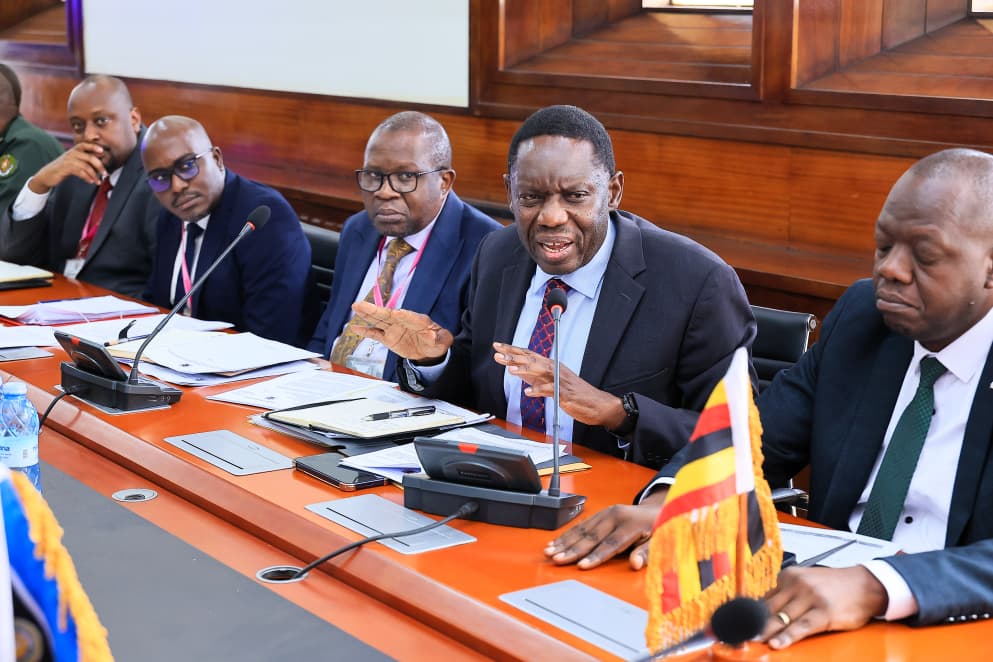
Col. Allan Kitanda, a UCSCU board member from Wazalendo SACCO, said the regulatory framework had not kept pace with the rapid growth of the cooperative sector.
“This sector is young. The laws that were in place were made at a time when we were not having this kind of growth. Sociologically, the laws must conform to the growth of the sector,” Kitanda said.
OBOTH STEPS IN
Speaker Oboth told both sides that the clash between the existing laws required a political and legislative solution.
“When two laws conflict or contradict each other, you need a Speaker to speak to both sides so they can see the difference, and everyone is left happy,” Oboth said.
He argued that legislation passed years ago should be reviewed where its implementation has failed to keep pace with changes in the sector.
The Speaker also warned that while Uganda must protect itself from international financial-compliance risks, Parliament could not ignore the concerns raised by SACCO members.
“While it is bad to be on a grey list as a country, it will also be a crisis if we do not listen to the petitioners,” he said.

Oboth further noted that courts had already declined to stop implementation of the regulatory framework, arguing that Parliament remains the appropriate avenue for changing the law.
“You cannot stop the operation of the law by using court; you can only do that when you do an amendment,” he said.
NEW SACCO ROADMAP
Following the deliberations, the meeting agreed on a phased approach to compliance.
Large SACCOs are expected to pick up licensing application forms within seven days as a demonstration of good faith.
SACCOs that make genuine efforts to submit their applications by March 31, 2027 will be given consideration under the proposed roadmap.
The Speaker also floated June 30, 2027 as a possible outer limit for the phased process, subject to BoU’s position.
At the same time, the Speaker directed the Minister of Finance to initiate an amendment Bill aimed at harmonising the legal framework governing registered societies and creating a SACCO-specific regulatory regime.

He further directed that a taskforce previously established to develop counter-proposals to the BoU regulatory framework be reinstated to follow up on the roadmap.
Governor Atingi-Ego, however, cautioned that any extension must be accompanied by concrete action from SACCOs, stressing that BoU’s regulatory position remains in force.
Speaker Oboth also told the cooperators to demonstrate willingness to comply by immediately picking up the application forms.
“But show willingness by picking the forms and returning them in time. The truth is that you will all be under BoU. They run the economy and their mandate is an international best practice,” Oboth cautioned.
GOT A HOT STORY? LET US KNOW!
Got breaking news, explosive secrets, or hard evidence?
Email us: redpeppertips@gmail.com
We accept tips, documents, videos, photos, and recordings—the more evidence you have, the better.
CONFIDENTIALITY IS OUR TOP PRIORITY. SOURCES ARE ALWAYS PROTECTED!
About Post Author