CLIMATE-SMART AGRIC DILEMMA! Sorghum Farmers Put Shs1.3tn UCSATP Project to the Test
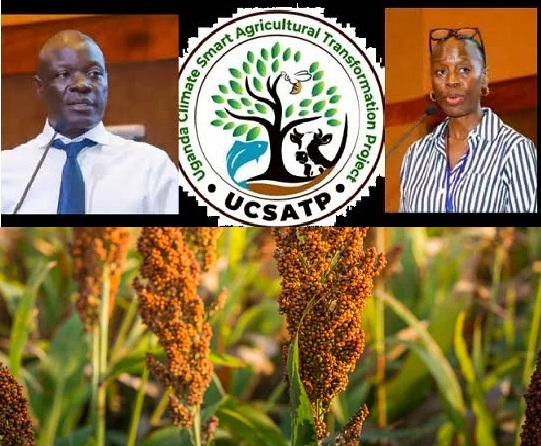
KAMPALA — Bosses of the multi-billion-dollar Uganda Climate-Smart Agriculture Transformation Project (UCSATP) appear to have found themselves in a tricky agricultural catch-22 — after sending researchers to Teso to find out whether the climate-smart technologies being pushed on sorghum farmers are actually working.
The project, funded by the World Bank to the tune of US$350 million (about Shs1.3 trillion) and implemented under the Ministry of Agriculture, Animal Industry and Fisheries, is designed to help Ugandan farmers withstand increasingly unpredictable weather.
But before celebrating the success of the climate-smart revolution, researchers have been dispatched to the Teso sub-region to ask a rather basic question: Are the technologies actually helping farmers?
The research could leave project bosses with a difficult answer.
If the technologies are working, farmers should be more resilient to drought and other climate shocks.
If they are not, the very programme designed to make agriculture climate-smart may have to rethink what it is putting in farmers’ hands.
The UCSATP leadership is headed by National Project Coordinator Eng. Boniface Okanya.
The project became effective on June 25, 2024, and covers 69 districts, with interventions ranging from modern irrigation and mechanisation to climate-smart seeds, roads and improved market access.
SORGHUM PUT TO THE TEST
The research, being implemented through the National Agricultural Research Organisation (NARO), is putting sorghum technologies under the microscope.
Dr Sarah Namirembe of Step Up Standard Limited, an organisation involved in mentoring young people in environmental sustainability, said the researchers want to establish whether the technologies promoted to farmers are delivering the benefits expected of them.
“We just want to know if these are helping them to be resilient to climate change,” Namirembe said.
And the researchers are not simply interested in whether sorghum survives a drought.
They want to know whether farmers actually like what they are growing.
Does it taste well? Does it mill well?
Namirembe said the study will examine improved seed varieties, production, processing and storage, including drought-tolerant, pest-resistant and early-maturing varieties.
The team will also look at whether the technologies meet farmers’ practical needs, rather than simply ticking boxes in project documents.
THE SORGHUM CATCH-22
Sorghum has long been regarded as a tough crop capable of surviving difficult climatic conditions.
But researchers say prolonged drought and changing weather patterns are now putting even this hardy crop under pressure.
Professor Charles Ssekyewa of the Centre for Ecosystems Research and Development in Entebbe said the study will examine how technologies developed and disseminated by NARO have been adopted and how they are performing in real farming conditions.
“We will work with young people as they engage communities to understand the technologies and practices currently being used by farmers,” he said.
This puts UCSATP bosses in something of an agricultural catch-22.
They are spending billions to promote climate-smart agriculture — but now need evidence from the farmers themselves to establish whether the technologies are actually delivering the promised resilience.
FROM LAB TO GARDEN
The study will consider both locally developed and imported technologies and innovations being used along the sorghum value chain.
Researchers will assess what happens from the moment farmers obtain seed to production, harvesting, processing and storage.
The team will also investigate technologies that farmers have adopted independently or copied from fellow farmers.
The researchers say this is important because a technology that looks impressive on paper may encounter a completely different reality once it reaches a farmer’s garden.
A variety may survive drought but fail the taste test.
Another may produce good yields but perform poorly at the milling stage.
For farmers, therefore, climate-smart does not automatically mean farmer-smart.
YOUTH JOIN THE INVESTIGATION
Professor Ssekyewa said young researchers will be involved in engaging communities and documenting the technologies and practices currently being used.
The project is also placing emphasis on research ethics.
Osborne Ahinbisibwe, research ethics manager at Uganda Christian University and head of its ethics centre, said researchers must ensure that communities and individuals providing information are protected.
He said participants can be vulnerable because researchers often have greater access to information, funding and resources.
The young researchers are consequently being trained on their ethical responsibilities, including handling and sharing research data.
BIG MONEY, BIG QUESTIONS
With US$350m behind UCSATP, the stakes are high.
The wider project is intended to transform Uganda’s agricultural sector by boosting productivity, improving market access and protecting farmers from climate-related shocks.
But the Teso sorghum study is effectively asking whether some of those ambitious plans are working where it matters most — on the farm.
The research is expected to run for three years and conclude in 2028.
Until then, UCSATP bosses may have to wait for the farmers’ verdict.
Because when it comes to climate-smart agriculture, the real examiner may not be the ministry, the researchers or the World Bank — it may be the sorghum farmer staring at the harvest.
GOT A HOT STORY? LET US KNOW!
Got breaking news, explosive secrets, or hard evidence?
Email us: redpeppertips@gmail.com
We accept tips, documents, videos, photos, and recordings—the more evidence you have, the better.
CONFIDENTIALITY IS OUR TOP PRIORITY. SOURCES ARE ALWAYS PROTECTED!
About Post Author