HOUSE OF MISSTEPS? Missed Targets, Stalled New Chambers & Procurement Gaps Exposed as Probe Flags Performance Cracks at Parliament Commission

Uganda’s powerful Parliamentary Commission—the engine that keeps the country’s legislature running—has come under intense scrutiny after a revealing Auditor General’s 2025 report exposed a troubling gap between money spent and results delivered.
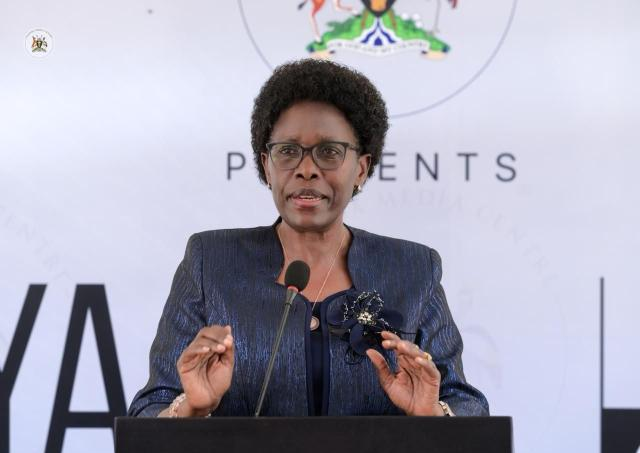
Chaired by Speaker Anita Annet Among and comprising top political heavyweights including Thomas Tayebwa, Robinah Nabbanja, Joel B Ssenyonyi, and Matia Kasaija, the Commission may have secured an unqualified audit opinion, but beneath that clean bill lies a catalogue of underperformance, delays, and system weaknesses that are raising eyebrows across the country. Clerk of the Parliament of Uganda Adolf Mwesige is the secretary.
At the center of the storm is a staggering funding-performance mismatch. Over the lifespan of its strategic plan from 2020/21 to 2024/25, the Commission had an approved budget of UGX 4,822.06 billion, yet only UGX 4,229.62 billion was actually released—leaving a shortfall of UGX 592.45 billion.
“This affected implementation of activities and denied the entity from meeting its strategic objectives,” the Auditor General stated, in a finding that cuts to the core of Parliament’s ability to deliver on its own plans.
And deliver it did not.
Out of 50 planned activities, only 19 were fully achieved, while 10 limped through partially, and a shocking 21 activities were not achieved at all—a performance that paints a picture of plans made but not executed.
Even alignment with national priorities showed cracks. The Commission scored 78.6 percent compliance in delivering outputs tied to the National Development Plan III, signaling moderate progress but far from excellence.
Yet in a twist of irony, revenue collection exceeded expectations, with UGX 401.53 million collected against a target of UGX 364.36 million—a rare win in an otherwise mixed report.
Annual budget performance appeared strong on paper, with UGX 974.80 billion warranted out of UGX 977.79 billion, achieving a near-perfect 99.7 percent release. But even this impressive figure could not shield critical operations from disruption.
The Auditor General pointed out that the shortfall, though minimal, affected acquisition of ICT software and procurement of new vehicles, exposing how even small funding gaps can have outsized operational consequences.
Delivery on outputs tells the real story. Only one output with five activities worth UGX 13.01 billion was fully implemented, while seven outputs covering 166 activities worth UGX 816.63 billion were only partially implemented—a massive chunk of Parliament’s work left hanging in limbo.
But it is the delayed construction of the new Parliamentary Chambers that has truly captured attention.
The project, expected to symbolize Uganda’s legislative strength, is now lagging behind schedule, with only 49 percent completion against a planned 69 percent by the end of the 2024/25 financial year.
Worse still, the completion date has been revised six times, with the latest target pushed to December 30, 2027.
For a flagship national project, the repeated delays raise serious concerns about planning, supervision, and value for money.
Procurement systems—meant to safeguard transparency—are also under fire.
The Commission failed to upload a comprehensive procurement plan on the e-GP system, instead relying on a vague, high-level summary.
“This does not meet the required level of detail for proper procurement planning,” the Auditor General warned.
Even more concerning, there was no multi-year procurement plan for procurements worth UGX 219.671 billion, raising red flags about long-term planning.
Transparency gaps deepen further. The Commission did not upload its approved disposal plan, and there was no evidence it had been published or updated in line with regulations.
Inside the system, things are no better. The e-GP platform lacks sufficient access rights to track communication between procurement actors, while it also failed to generate mandatory reports—forcing officials to prepare them manually outside the system.
“This hinders adequate online assessment of procurement performance,” the report notes.
The ripple effects are already visible. Vote controllers reportedly lacked visibility into procurement across departments, leading to procurement splitting, inappropriate methods, and reliance on a limited pool of bidders—a combination that undermines fairness and efficiency.
Asset management, too, is in disarray.
The Commission operates without an asset management policy, meaning there are no formal procedures to track how public assets are used.
The asset register itself is riddled with inconsistencies—missing purchase dates, absent tag numbers, unclear classifications, and mismatched service timelines.
Taken together, the findings reveal an institution that, while financially compliant, is grappling with execution challenges at nearly every level.
For the body entrusted with overseeing government accountability, the irony is impossible to ignore.
As pressure builds, Ugandans are now watching closely.
Because when Parliament itself is flagged for missed targets, delayed projects, and weak systems—the question becomes unavoidable:
Who watches the watchdog?
GOT A HOT STORY? EMAIL: redpeppertips@gmail.
SOURCE PROTECTION/CONFIDENTIALITY IS OUR NO.1 PRIORITY.
About Post Author