How mafia forced M7 to renew URA boss’s contract
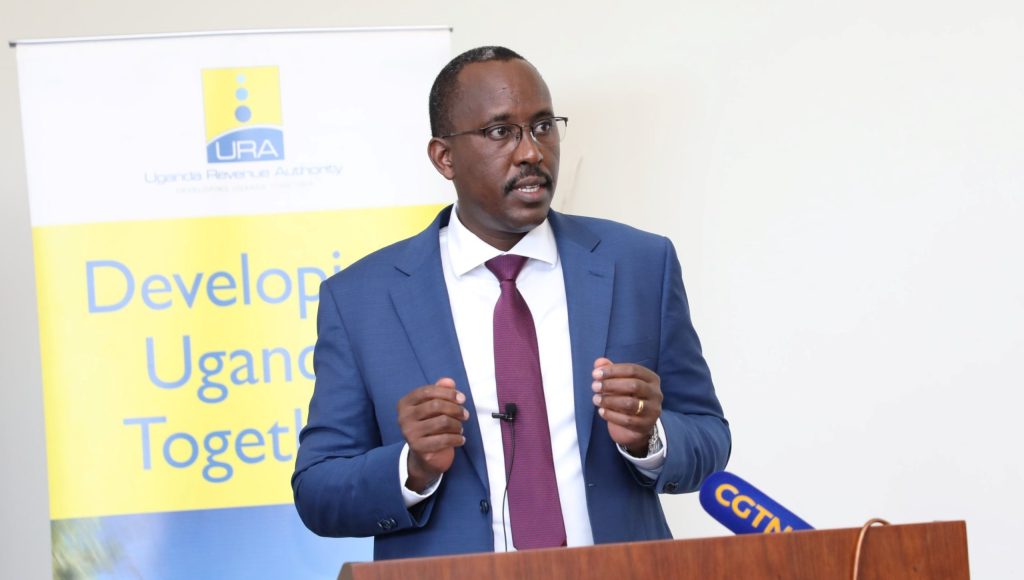
The Uganda Revenue Authority (URA) has confirmed the reappointment of commissioner general John Rujoki Musinguzi for another term by President Museveni.
This has been confirmed in a notice by the Nakawa based tax collection body.
“The board and staff of Uganda Revenue Authority congratulate Commissioner General – John R. Musinguzi on his remarkable reappointment for another term as a team lead of the URA Family.
“This momentous occasion reflects the unwavering trust and support extended by the President of Uganda, Yoweri Museveni, Matia Kasaija, Minister of Finance, and the esteemed board of the Uganda Revenue Authority.
“This collective endorsement underscores a unified commitment to our nation’s fiscal integrity and prosperity.
“Together, we embark on this continued journey with enthusiasm and a shared vision for a brighter, more prosperous Uganda,” the notice read.
Musinguzi was first appointed as commissioner general in 2020, replacing Doris Akol.
Under his stewardship, total revenue collected has reached 16.4 trillion (fiscal year of 2022/2023), surpassing the target of Shs16.1 trillion and resulting in a surplus of Shs236.8 billion.
In the same period, direct domestic taxes collected exceeded the target with a surplus of Shs724.62 billion, while non-tax revenue, including stamp duty and embossing fees, generated a surplus of Shs65.8 billion.
Musinguzi’s tenure has also seen the tax base expand, with the number of registered in the FY 2022/2023 increasing by 882,286 indicating a growth of 33.7%.
By the end of the fiscal year, the total number of taxpayers on the register was 3,500,294 among them, 194,143 were non- individuals, while 3,306,151 were individual taxpayers.
GAMES URA MAFIA PLAY
Information obtained indicates that before Rujoki came in, the Nakawa based tax body had been captured by an Octopus (organization) composed of the mafia whose interest was money.
This octopus organization, according to a brief seen by this publication, had managed to create a patronage and a corrupt system that they would exploit for their self-enrichment through constant manipulation of the tax body systems, processes, policies and activities.
It comprised among others, individuals who had been at the tax body for a long time and serving in senior positions, tea girls, cleaners, drivers, Askaris, and clearing agents-all with a defined reporting structure.
The brief added that at the tax body, this Octopus organization became a juggernaut of improprieties, whose members placed themselves above scrutiny, transparency and accountability.
Museveni, shocked, decided to bring in thick skinned John Musinguzi Rujoki to take the mafia head on in 2020.
Three years later, Rujoki has managed to crush this mafia to the satisfaction of President Museveni who has now decided to extend his tenure for a complete mop up of some elements who could be still hiding within the systems.
The President also reportedly relied on a recent IGG report which exonerated Rujoki and pointed some issues to fix.
Here is a brief Rujoki relied on to crack the whip in the last 3 years.
TAX EVASION AT THE BORDER POINTS
Before Rujoki came in, the brief indicated that the mafia had been conniving with unscrupulous business people to evade the payment of taxes. The mafia would position their army of boys at the borders to facilitate this. The first trick had been to facilitate companies to import goods claiming that they were in transit. This is known as dumping.
With the help of the mafia, it is alleged that some traders have been passing their goods into the country disguised as being in transit to the neighbouring countries like South Sudan, Rwanda and DR Congo but actually selling them in the Ugandan market to dodge the high taxes.
These commodities are sold cheaper than others of the same brand and quality. With help of the mafia most of the goods would pass through URA gazetted, manned and patrolled areas, main roads and Lake Victoria.
Investigations show the areas of Eastern and Central Uganda top the list. Little smuggling activity has been registered in the Southern and the Northern areas of Uganda.
The most commonly dumped commodities into Uganda as preferred by the mafia include among others cigarettes, wines and spirits, polythene bags, oil and petroleum products. Rujoki has vigorously fought this vice in the last 3 years and is ready to completely eradicate it now that he has been reappointed.
FALSE DECLARATION
Another trick by the mafia, pre-Rujoki period, has been to demand bribes and connive with businessmen to under-declare their goods or falsify the goods they are importing.
For example, say a container marked to be carrying baby diapers on closer inspection is also found to be carrying milk powder. Or where shoes have been imported, the record may read slippers.
The slippers attract a lower value and the difference is an automatic profit. In one of the incidents, the mafia at URA illegally cleared containers of shoes, electrical appliances and other high value goods using forged Kenya Revenue Authority declarations.
The transit documents were validated by the mafia URA staff and the trucks were allowed to proceed to the sales stores without reporting to the Inland Container Depot/ bond as per procedure.
The goods were mis-declared as raw materials such as whiting and calcium carbonate and would be cleared in Kampala Customs Business Centre, without being verified.
Two Internal Container Depots (W0078 — Multiple and W0246 Maina Speedy) were reportedly used. A review of the URA investigation report showed that 102 consignments with a tax value of sh5.4b had been dumped without paying taxes.
Another case was when the mafia managed to clear consignments worth sh5.2b. The entries C46080 and C46083 for Malaba border point were for fresh pasteurised milk, entry C22 for Oraba, Southern Sudan had aeroplane parts and C95725 for Kampala had assorted spoons and forks. They were entered on documents for temporary imports to be re-exported or entered for home consumption after paying taxes.
Rujoki has vigorously fought this vice in the last 3 years and is ready to completely eradicate it now that he has been reappointed.
CARS TAXES
Pre-Rujoki days, the mafia was also involved in clearing cars into the country without paying all the taxes. Some would be helped to get fake number plates.
There was a case at Mbarara customs station, where mafia URA officials registered a Mercedes Benz number UAJ 909B in the names of Kiberu Collins Richard. The system registered another motor vehicle Toyota Corsa in the names of Hakiiza Ronnie with the same number but differentiated it by adding a dot at the end.
The Corsa was released without paying the due taxes and assigned log book number LB146603. URA has been on several occasions forced to recall cars, some of them luxury suspected to have been imported and registered illegally by tax evading cartels in URA—the mafia.
URA has also been severally accused of setting up parallel importation invoices for cars which gave a chance to the mafia to engage in invoice manipulation. When cars are imported into Uganda, URA normally disregards the original invoice and sets their own values.
Rujoki has vigorously fought this vice in the last 3 years and is ready to completely eradicate it now that he has been reappointed.
FORGED BOOKS
During the pre-Rujoki days, the URA mafia was also fond of helping businessmen to prepare different books of accounts. And in turn certain companies and individuals would end up with one set of accounts for the taxation purposes and another for the actual business transactions.
A case in point was the revelation by the commission probing the URA a few years ago where a sh2.4 b revenue loss was incurred. In a raid on the premises of Karim Hirji, a tycoon who owns a string of hotels in the city, the Special Revenue Protection Services (SRPS) seized incriminating evidence.
It included cash analysis books, two different sets of accounting books for each hotel. One book was doctored for tax purposes and another was the official one.
Rujoki has vigorously fought this vice in the last 3 years and is ready to completely eradicate it now that he has been reappointed.
FRUSTRATION AND RED TAPE
In the pre-Rujoki days, the URA mafia tried hard to frustrate the introduction of scientific measures aimed at supporting tax compliance. For instance the mafia fought tooth and nail to frustrate the digital stamp system by colluding with manufacturers but they were eventually defeated on this.
Even when the online tax payments system was introduced, the mafia interfered with it to an extent that sometimes the ministry of finance was not getting complete figures. The plan was to fail it.
The mafia preferred the old methods where they would frustrate businesses through red tape (in the process of paying the taxes due to inappropriate technology) and bureaucracy. Human interaction which was an avenue for soliciting bribes was at stake, a reason they tried to frustrate them.
Rujoki has vigorously fought this vice in the last 3 years and is ready to completely eradicate it now that he has been reappointed.
TAX ARREARS CLEARANCE
The other trick the mafia was engaged in pre-Rujoki period at URA was to help businessmen pay less in tax arrears. The mafia at the top would slap a tax arrears assessment of for-instance shs10bn. The businessmen then had to first reject the assessment and provide a room for renegotiation.
The mafia would then covertly send their boys to negotiate with the businessmen with promises to help them have their objection allowed. Instead of Shs 10bn, the arrears could be reduced to something like Shs 5bn or less depending on how well the mafia has been oiled.
For-instance, URA staffer was recently sentenced to a fine of Shs8m and barred from holding a government office for the next 10 years after he confessed to soliciting and taking a bribe. Ferdinand Albaker Wamala, a former URA accountant, was convicted on two counts of corruption.
He had been arrested by State House Anti-corruption Unit in a joint operation with police for allegedly receiving Shs45m, being a bribe from a businessman in Jinja District, Abdulnoor Okumu Ikaata, to help him evade taxes worth Shs3bn.
Court heard that Ikaata, a sugarcane grower in Busoga Sub-region, received a tax arrears assessment of Shs3.7bn covering the January 2012 to December 2017 period from URA but upon complaining, Wamala promised to help him have his objection allowed. Wamala asked for a meeting with Ikaata outside the office and solicited money from him to reduce his tax liability.
Similarly, not long ago, the Court of Appeal upheld a High Court sentence of three years imprisonment imposed on a URA supervisor Deo Imere, convicted of soliciting a bribe to reduce a billion tax into mere millions of shillings for a Kampala trade company. Imere was a supervisor in the Domestic Tax Department.
It had been submitted by the prosecution that Imere and two other URA officers, at the Crested Towers, were assigned to audit Lubmarks Investments Ltd. They assessed the company in taxes amounting to shs1,091,878,753, which the company disputed and asked for more time to produce records to support its dissatisfaction. Court found him guilty of soliciting sh100m for his own gain in exchange of reducing tax from a total of sh1,019,878,753 to mere sh230m.
Rujoki has vigorously fought this vice in the last 3 years and is ready to completely eradicate it now that he has been reappointed.
GODFATHERISM
Before Rujoki, the mafia at URA also boasted of connections with top figures in Government. As a result they operated as a criminal enterprise, contemptuous of laws and regulations and dealing ruthlessly with whoever was seen as standing in their way. They have been exaggerating the protection they enjoy from their God fathers.
“The impression they created was that this is a jungle country in which anyone with the right connections can operate above the law and there is nothing anyone can do about it, “the brief report pointed out.
Rujoki, whom you can’t threaten with connections (because he can access the president whenever he wants), has vigorously fought this vice in the last 3 years and is ready to completely eradicate it now that he has been reappointed.
FAMILY MEMBERS
Before Rujoki, the mafia would also use their family members to register companies and as well cut deals for them to elude scrutiny. The same companies would in turn be major suppliers of URA.
Rujoki is also fighting this vice. It however goes without mention that a firm linked to him was last year caught up in Uganda Printing and Publication Corporation (UPPC) mess. But this is a story for another day.
SEXUAL NETWORK
It has also emerged that among other tricks the mafia used at URA was the creation of a massive sexual network. On top of amassing wealth, these also turned their whoppers into weapons of mass destruction and they had no taste—the ugliest, cute, old, interns, cleaners, PAs, secretaries and managers.
These sexual networks would then sometimes help them in executing their corrupt deals. This explains why some of the officials sacked after Rujoki came in were on moral grounds. The probe found out that one official had impregnated 17 girls/women at the tax body and he had slept with over 200 girls/women.
Rujoki has vigorously fought this vice in the last 3 years and is ready to completely eradicate it now that he has been reappointed.
WE CAN DO BETTER
It is because of these tricks by the mafia at URA that Uganda had failed to collect the much desired revenue.
This is why Rujoki was brought in.
Better results are expected now that his contract has been extended.
The mission is now to weed out all the remaining mafia/ kawukumi.
Uganda’s development partners insist Uganda is collecting less tax revenue than its neighbours in the region and many countries in sub-Saharan Africa.
A 2018 World Bank Economic Update for Uganda (11th Edition) was damning. It assessed Uganda’s domestic revenue performance and concluded that the country was “doing poorly compared to its peers and its potential”.
According to the report, Uganda’s tax-to-GDP ratio is just under 14 per cent—lower than the ratio in neighbouring Kenya (18 per cent) and Rwanda (16 per cent). The tax-to-GDP ratio is also below the broader COMESA and sub-Saharan Africa averages.
The report noted that Uganda has the potential to collect revenues of above 20 percent of GDP over the medium term. “Reforms are required to put the revenue-to-GDP ratio on an upward trajectory so that Uganda moves towards its potential, and raises sufficient resources to finance its growth and development priorities,” wrote Diarietou Gaye, country director for Eritrea, Kenya, Rwanda and Uganda in a foreword.
DEAR READER, DO YOU HAVE A HOT STORY YOU WOULD LIKE US TO PUBLISH…
FRAUD IN BANKS, BETTING FIRMS, CHEATERS, DIVORCE FILES, S3X NETWORKS, S3X FOR MARKS, HARASSMENT OF ALL NATURE AT OFFICE BY YOUR BOSS, CHILD NEGLECT, WETLAND OCCUPATION, ENVIRONMENTAL DEGRADATION, VIDEOS, IMPUNITY or CORRUPTION (in government agencies/ MDA’s, NGOs, Ministries, Private sector), FIGHTS IN OFFICES, JOB WARS/ WITCH HUNT, URA TAX FRAUD/NON-COMPLIANCE, INVESTOR FRAUD, CHEATING MONEY LENDERS, BUSINESS WRANGLES, SUBSTANDARD PRODUCTS, GOLD SCAMS, NSSF REMITTANCES NON COMPLIANCE, LAND ISSUES, INTERNAL AUDIT REPORTS EXPOSES, POLITICAL WRANGLES…ETAL.
CALL/TEXT/WHATSAPP 0777959024
SOURCE PROTECTION/CONFIDENTIALITY IS OUR NO.1 PRIORITY.
About Post Author