KITEEZI TRASH TRAGEDY! KCCA ED Kisaka speaks out, explains challenges of city population growth
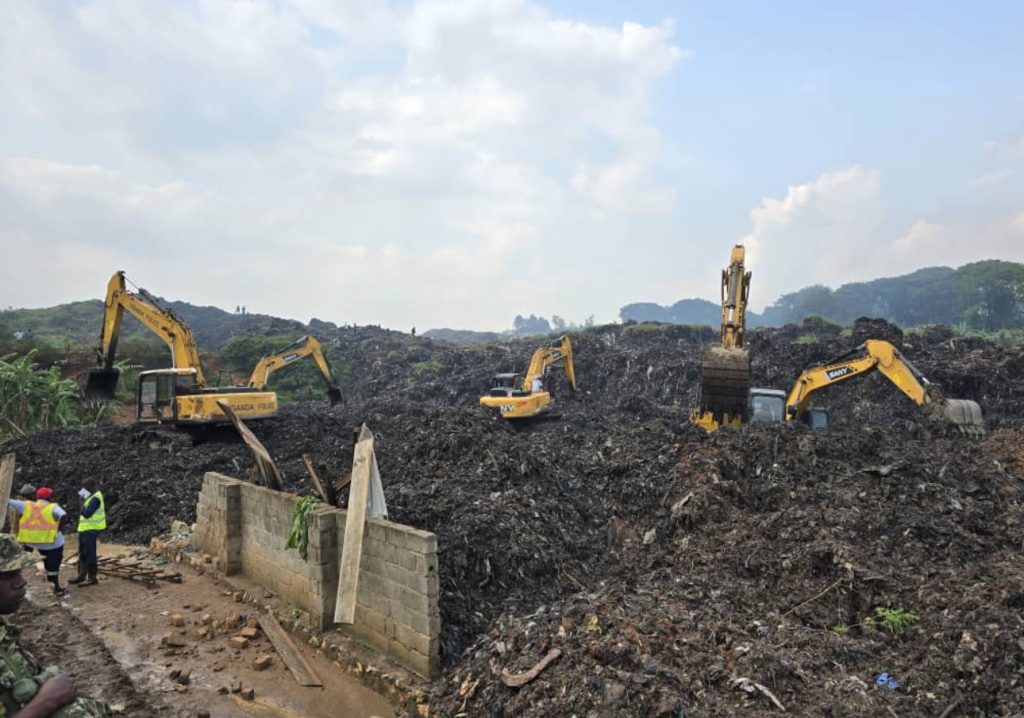
On Saturday morning the country woke up to the news of the collapse of Uganda’s largest and the only landfill in the Kampala metropolitan area.
Apparently, the tragic incident has resulted in the death of over 20 people and destruction of property.
Following this incident, President Museveni has since sanctioned the Deputy Inspector of Government (IGG) Anne Muhairwe to expedite investigations into what exactly went wrong.
Prior to this, the President also informed the country that he received enough information from the Kampala Capital City Authority (KCCA) Executive Director Dorothy Kisaka on the same.
According to the President, Kisaka told him the story of how they wanted to move to Dundu in Mukono but residents there did not want to neighbour with the rubbish and instead KCCA have been working positively using the rubbish to generate electricity, make manure, recycle the plastics, acknowledging it as a good idea.
However, the President didn’t get an answer to the question of why human settlement was allowed near the heap and this could have informed him to sanction the investigations on the matter.
Speaking to this publication, Kisaka revealed that Kiteezi KCCA landfill has not had a bad track record despite servicing a high growing population.
According to Kisaka, Kiteezi landfill lies on 36 acres of land in Wakiso district which was established in 1996.
It serves the districts of Wakiso, Kampala and Mukono.
She says the KCCA Kiteezi landfill offices reports show that Kiteezi receives 170 garbage trucks every single day representing 1200 tons of garbage from the three districts.
She explained that it is stretching that the dumpsite serves three administrative areas of Kampala, Mukono and Wakiso though the burden of taking care of the landfill is borne by only KCCA.
Kisaka added that Kiteezi rubbish has over the years steadily grown due to increasing population in the urban areas leading to over utilization of the landfill site resulting in a hill or garbage mountain.
Accordingly, efforts to manage wastes in the city are continuously overwhelmed by the ever-increasing population of city residents, increased levels of economic activity, and reduced funding from central government.
But there is a good side.
She noted that the landfill is frequented by hundreds of litter pickers who derive a livelihood from the landfill through recycling activities.
She further revealed that last year, KCCA mooted plans to have a waste-to-energy plant near the landfill as an alternative of putting the collected garbage into good use.
She cited that cities globally are opting for cleaner alternatives of taking care of garbage by converting it into energy.
She says KCCA is currently in advanced stages of the waste-to-energy plant establishment once all government licensing is done.
Waste-to-energy plants burn municipal solid waste (MSW), often called garbage or trash, to produce steam in a boiler, and the steam is used to power an electric generator turbine.
SOLID WASTE MANAGEMENT DILEMMA
According to the United Nations Environmental Body (UNEP), the increasing volume and complexity of waste associated with the modern economy is posing a serious risk to ecosystems and human health.
Every year, an estimated 11.2 billion tonnes of solid waste is collected worldwide and decay of the organic proportion of solid waste is contributing about 5 percent of global greenhouse gas emissions. Every year, an estimated 11.2 billion tons of solid waste are collected worldwide.
Of all the waste streams, waste from electrical and electronic equipment containing new and complex hazardous substances presents the fastest-growing challenge in both developed and developing countries.
The solution, in the first place, is the minimisation of waste. Where waste cannot be avoided, recovery of materials and energy from waste as well as remanufacturing and recycling waste into usable products should be the second option.
Recycling leads to substantial resource savings. For example, for every tonne of paper recycled, 17 trees and 50 per cent of water can be saved. Moreover, recycling creates jobs: the sector employs 12 million people in Brazil, China and the United States alone.
The UNEP International Environmental Technology Centre (IETC) in Japan supports the implementation of integrated solid waste management systems. Its work also focuses on the proper treatment of special wastes (electronics, agricultural biomass, plastics) in developing countries. IETC aims to optimize the management of solid waste by involving all stakeholders in the process through pilot projects at local level.
DEAR READER,
CALL/TEXT/WHATSAPP:0777959024 OR EMAIL: redpeppertips@gmail.com WITH AS MUCH EVIDENCE AS POSSIBLE IF YOU HAVE A HOT STORY YOU WOULD LIKE US TO PUBLISH…
SOURCE PROTECTION/CONFIDENTIALITY IS OUR NO.1 PRIORITY.
About Post Author