MINERAL MAFIA! Report Unmasks Illegal Dealers, Billions Lost, Ghost Licenses & Idle Projects at the Heart of Uganda’s Mining Sector Under Energy Ministry Watch
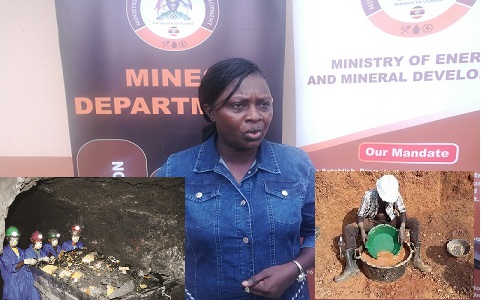
Under the spotlight for all this mess now is Agnes Alaba, the Commissioner for the Geological Survey and Mines Department (often referred to as Commissioner for Minerals/Mines) at the Ministry of Energy and Mineral Development (MEMD). She oversees mineral development, including managing geological infrastructure and the digital mining cadaster
A storm is raging beneath Uganda’s mineral wealth, and the glitter of gold and rare earths is now being overshadowed by a dark, explosive trail of illegality, mismanagement, and systemic failure that has left billions slipping through the cracks as authorities at Energy Ministry scramble to contain a sector spiraling into chaos.
The latest 2025 Auditor General’s report on the Mineral Development Programme has peeled back the layers of a deeply troubled system where laws exist on paper but are brazenly ignored in practice, exposing a thriving underground network of unlicensed dealers, stalled government projects, weak enforcement, and a dangerous absence of clear direction in one of Uganda’s most lucrative sectors.
Under the spotlight for all this mess now is Agnes Alaba, the Commissioner for the Geological Survey and Mines Department (often referred to as Commissioner for Minerals/Mines) at the Ministry of Energy and Mineral Development (MEMD). She oversees mineral development, including managing geological infrastructure and the digital mining cadaster.
At the center of the scandal is a blatant violation of Section 140(1) of the Mining and Minerals Act, which clearly prohibits the buying and selling of minerals without a valid license. Yet despite this legal clarity, at least seventeen traders were found actively dealing in minerals without any mineral rights or dealer’s licenses. This is not just a technical breach — it is a direct assault on government authority, opening floodgates to illegal mining, theft, and cross-border smuggling while denying the state critical revenue.
The consequences are staggering. Every unlicensed transaction chips away at government earnings, weakens regulatory oversight, and fuels a shadow economy that thrives beyond the reach of tax authorities. While the Ministry insists that over 30 illegal outlets in Kampala have been shut down in collaboration with the Police Mineral Protection Unit, the reality remains that the illegal trade had already taken root and flourished under the watch of those tasked with controlling it.
Even as the Ministry promises to tighten systems, join the URA single window, and establish formal mineral markets, the damage has already been done, exposing glaring enforcement gaps that allowed rogue operators to infiltrate and exploit the system.
But the rot does not stop at illegal dealers. In Ntungamo and Fort Portal, two beneficiation centers constructed in 2023 — meant to revolutionize local mineral processing and empower communities — stand as silent, hollow shells. Built without the essential equipment needed to function, these centers are completely non-operational, unable to deliver the very value-addition they were designed for.
What was supposed to be a bold step toward industrialization has instead turned into a monument of poor planning and delayed execution. Communities that were promised better earnings through value addition remain stuck exporting raw, low-value minerals while waiting for equipment that was expected to arrive in March this year. Red Pepper could not verify if it has been delivered by press time.
The deeper crisis lies in the absence of clear guidance on mineral value addition. While some minerals like gold and sponge iron have prescribed purity levels, the majority of Uganda’s mineral commodities operate in a regulatory vacuum. Critical minerals such as tungsten and tantalum are being exported without any defined purity thresholds, despite ongoing mining activity.
This lack of direction is not a minor oversight — it is a structural failure that allows exporters to ship out minimally processed minerals, depriving the country of higher earnings, stifling industrial growth, and encouraging illegal trade. Without clear rules, enforcement becomes impossible, and Uganda continues to lose out on the full economic potential of its mineral wealth.
The Ministry’s response — commissioning a Mineral Value Chain Analysis study — signals recognition of the problem, but also underscores how long the sector has been operating without a comprehensive roadmap.
Meanwhile, billions meant to benefit communities are stuck in limbo. Out of UGX 5.862 billion received in mineral royalties, alongside an opening balance of UGX 3.913 billion, only UGX 8.33 billion was distributed, leaving UGX 1.443 billion unpaid. These are funds meant to be shared among government, local authorities, and landowners, and delays in disbursement threaten to ignite disputes and tensions over resource ownership.
Although payments to districts like Kamwenge and Kitagwenda are reportedly being processed, the existence of “unknown beneficiaries” raises troubling questions about record-keeping and transparency in a sector where clarity is critical.
At the same time, the government is losing even more through delayed royalty payments. UGX 2.82 billion in assessed mineral royalties remains unpaid beyond the legally mandated 30-day period. This is not just a delay — it is a breakdown in enforcement, allowing companies to sit on obligations while government services go underfunded.
Despite issuing notices of non-compliance and engaging the Attorney General and URA, the persistent backlog highlights weak follow-through and insufficient deterrence for defaulters.
The licensing system itself is riddled with irregularities. Ten mining licenses faced delays in conversion, while eight applicants were granted licenses without proper evaluation, raising serious concerns about due diligence and transparency. Even more alarming, 114 license applications were delayed for over 100 days, creating bottlenecks that slow investment while simultaneously allowing questionable approvals to slip through.
In a shocking twist, fourteen exploration areas were found hosting full-scale mining operations far beyond what their licenses permit. It is a blatant abuse of the system, turning exploration permits into backdoor entry points for unauthorized extraction.
The chaos is compounded by the absence of a standardized framework for reporting mineral resources. Uganda lacks a recognized national reporting code, an accredited registry of competent professionals, and a structured system for documenting mineral assets. In a sector where accuracy and credibility are everything, this gap leaves room for manipulation, misreporting, and loss of investor confidence.
Even the Uganda National Mining Company Limited, expected to anchor the country’s mining ambitions, is grappling with its own internal crises. Dr. Gerald Banaga-Baingi serves as the CEO with James Mukasa Ssebugenyi chairing the board.
A receivable of UGX 1.0 billion from government shareholders remains unpaid, leaving the company undercapitalized and struggling to operate effectively.
Procurement performance is dismal, with only 28.4 percent of planned procurements executed. Contracts worth UGX 921 million were completed out of a planned UGX 2.86 billion, while some contracts were awarded without proper management structures. Payments totaling UGX 76.2 million were made without supporting procurement files, raising red flags about accountability and financial discipline.
Funding shortfalls have further crippled operations, with the company receiving only 43 percent of its approved budget, leaving a gap of UGX 5.4 billion. Critical activities such as recruitment, ICT acquisition, and office setup have all been affected, stalling progress in a sector that demands rapid development.
Perhaps most damaging of all is the company’s failure to secure the government’s mandatory 15 percent equity stake in seven mining licenses issued after the 2022 law came into force. This single lapse could cost the country significant future revenue, effectively handing away a share of its mineral wealth.
As the revelations pile up, one thing becomes painfully clear: Uganda’s mineral sector is sitting on immense wealth, but the systems meant to manage it are leaking from every corner. Illegal dealers operate freely, projects stall before they begin, laws go unenforced, and billions remain uncollected or undistributed.
“The Auditor General’s findings are not just a routine report — they are a warning siren. Without urgent reforms, tighter enforcement, and real accountability, the country risks watching its mineral riches slip away into the shadows, leaving behind nothing but missed opportunities and a legacy of systemic failure,” a mineral expert told Red Pepper for this story.
GOT A HOT STORY? EMAIL: redpeppertips@gmail.
SOURCE PROTECTION/CONFIDENTIALITY IS OUR NO.1 PRIORITY.
About Post Author