MSC MONEY MELTDOWN! Sh62bn Loan Write-Offs, Unlicensed Sacco Loans, Chaotic Lending, Idle Emyooga Billions, Losses Expose Weaknesses at Microfinance Support Centre
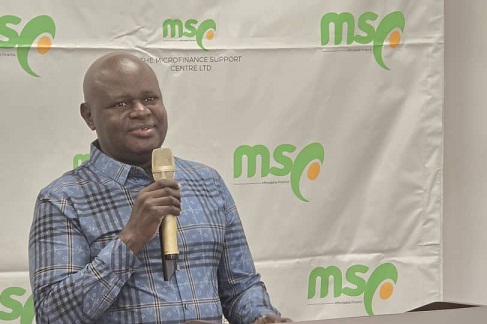
A financial storm has erupted at Microfinance Support Centre Limited, exposing a trail of massive loan write-offs, weak recovery systems and questionable lending practices that now place Executive Director John Peter Mujuni and Board Chairperson Kiiza Aliba Emmanuel squarely in the spotlight.
At the heart of the crisis is a 2025 Auditor General report revealing a staggering UGX.62.53 billion in loan write-offs, a move that has shaken the institution’s financial standing and pushed it into a UGX.22.67 billion loss. The report pulls no punches, stating plainly that “the Company made loan write-offs worth UGX.62.53Bn in respect of receivables, and this affected the reported performance for the year, contributing to a loss of UGX.22.67Bn.” For an institution mandated to empower Ugandans through affordable credit, the figures have triggered alarm across the financial sector.
Insiders say the write-offs are just the tip of the iceberg. Deep within the system, the auditors found inefficiencies in loan processing which are crippling operations. Seventeen loans worth UGX.7.78 billion took far longer than expected to be processed, with some dragging on for over a year. “17 loans worth UGX.7.78Bn disbursed during the year exceeded the maximum lead times prescribed and sometimes even took over a year to complete processing,” the report reveals, painting a picture of bureaucratic delays that are costing both time and money.
Even more troubling is the revelation that billions were disbursed to entities operating outside the law. “Loans amounting to UGX.2.725Bn were paid out to various SACCOs, however, these SACCOs did not possess valid operating licenses from UMRA contrary to the credit policy of the company.” This breach of policy has raised serious concerns about due diligence and risk management within the institution. “You cannot lend public funds to unlicensed entities and expect accountability,” a financial expert remarked to RedPepper.
The cracks widen further when it comes to risk assessment. The report notes that “the Company applied outdated collateral values to loans worth UGX.6.526Bn… with some dating back as far as 9 years ago.” This means the institution has been making lending decisions based on obsolete data, potentially understating its exposure to risk. “That is like driving while looking in the rear-view mirror,” an insider said.
Despite ambitious plans backed by a colossal UGX.1.792 trillion strategic funding target, the company managed to realise only UGX.969.37 billion, leaving a gaping shortfall of UGX.823.48 billion. At the same time, government support also fell short, with only UGX.133.341 billion received out of the appropriated UGX.161.23 billion, leaving a variance of UGX.27.894 billion.
But perhaps the most shocking revelation is the failure to recover money already written off. The report highlights that “projected collections from written-off loans totalled to UGX.1.271Bn… the company only realised UGX.0.167Bn… posting an under collection of UGX.1.104Bn.” This dismal recovery performance has deepened concerns about the institution’s ability to safeguard public funds.
Meanwhile, billions meant for lending are sitting idle or underutilised. Out of UGX.44.7 billion planned for disbursement, only UGX.23.4 billion was actually lent out. Even under the flagship Emyooga programme, UGX.120.996 billion was spent out of UGX.134.206 billion, leaving UGX.13.210 billion unused.
The loan book itself is under severe stress. As of June 2024, UGX.83 billion in conventional loans remained outstanding, with non-performing loans standing at a staggering 52%, equivalent to UGX.44.7 billion. “A 52 percent default rate is not just high—it is catastrophic,” a banking analyst warned, describing it as a sign of systemic failure in loan recovery.
Adding to the governance concerns is the absence of a client service charter, meaning clients are left in the dark about their rights, obligations and service standards. “The company does not have an approved client service charter that informs clients and stakeholders,” the report states, exposing a major gap in accountability and transparency.
As the revelations pile up, pressure is mounting on John Peter Mujuni and Kiiza Aliba Emmanuel to explain how an institution created to uplift the financially vulnerable has found itself entangled in inefficiencies, weak controls and massive financial losses. “This is not just about numbers,” a concerned observer said. “It’s about trust, and right now, that trust is hanging by a thread.”
GOT A HOT STORY? EMAIL: redpeppertips@gmail.
SOURCE PROTECTION/CONFIDENTIALITY IS OUR NO.1 PRIORITY.
About Post Author