NSSF UNDER FIRE! Probe Exposes Shs9.6BN Unsecured Uganda Clays Loan, Weak Oversight of 5 Multibillion Associate Companies
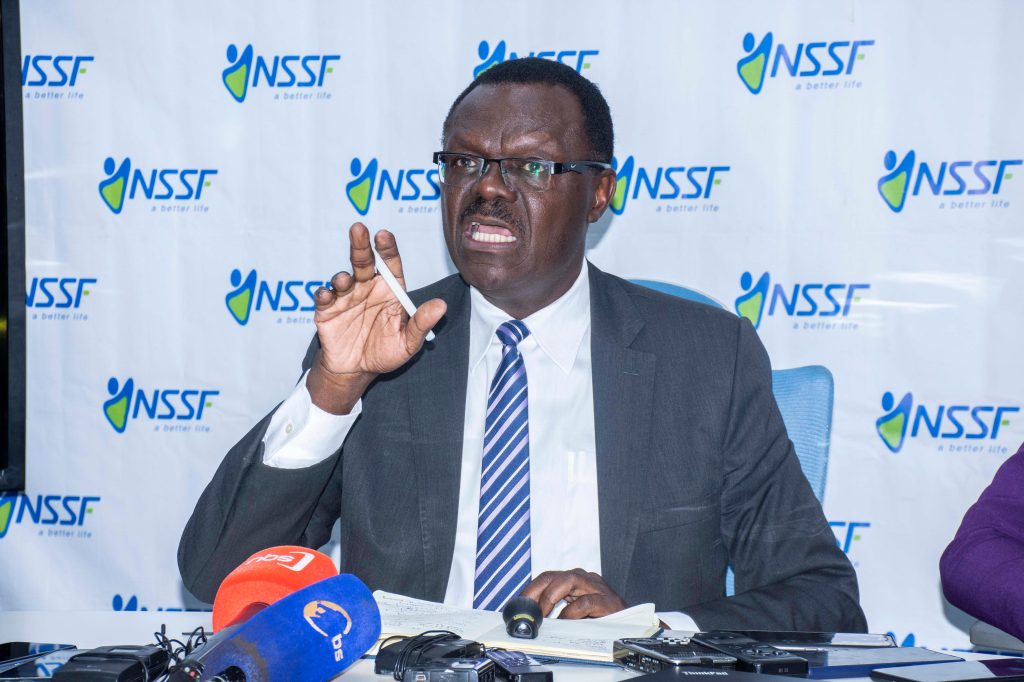
NSSF Managing Director, Patrick Ayota
KAMPALA: The National Social Security Fund (NSSF) has come under scrutiny after the Auditor General flagged weaknesses in the Fund’s oversight of its associate companies, including failure to have documented guidelines governing its representatives on company boards and insufficient collateral for a restructured loan to Uganda Clays Limited.
The Auditor General’s report as of December 2025 noted that NSSF did not have documented Terms of Reference (TOR) or other guidelines specifying the role, authority and responsibilities of Fund representatives serving on the boards of its five associate companies, as well as how the Fund’s significant influence would be exercised.
The audit also found that the Fund did not have sufficient collateral for the restructured loan to Uganda Clays.
The same issues came under scrutiny during a COSASE interface with NSSF, where the Auditor General’s finding on board representation was read into the record by the Chairperson Muwada Nkunyingi (Kyadondo East MP).
“I noted that the Fund lacked documented terms of reference or guidelines specifying the role, authority and responsibilities of the Fund’s board representatives in associate companies, and how the Fund’s influence would be exercised,” the Auditor General’s finding stated.
The matter was further examined during discussions concerning NSSF’s investment in Uganda Clays, particularly questions surrounding the Fund’s representation and its ability to protect public money invested in its associate companies.
NSSF Managing Director Patrick Ayota acknowledged that the Fund had not previously had formal terms of reference for employees or representatives it sent to investee companies.
“The first issue was basically that we did not have terms of reference for people we send to our investee companies to represent the Fund. What are their responsibilities? What should they do?” Ayota told the Committee.
He explained that developing the guidelines had taken time because representatives serving on boards of companies are also subject to confidentiality requirements.
Ayota said NSSF had considered governance practices in other markets, including the United Kingdom and South Africa, before preparing what he described as a comprehensive draft.
The Committee, however, questioned the implications of having NSSF representatives on boards without clear written terms defining their responsibilities to the Fund.
The Chairperson pointed out that the matter was more than a mere formality, particularly because NSSF is a majority shareholder in some of the companies and needs to ensure that its interests are properly represented.
“For example, you’ll find that you are the majority shareholder in some company, but the person you send doesn’t have terms of reference,” the Chairperson observed.
Ayota acknowledged the gap, saying the new guidelines were intended to address the issue.
According to him, the draft was prepared in 2026 and was expected to go before the NSSF Board for final approval.
When asked whether the document had already appeared before the Board, Ayota said it had not, adding that the Board was scheduled to meet on August 13.
NSSF Corporation Secretary Agnes Tibayeita Isharaza confirmed that the review of the guidelines was an agenda item for the upcoming Board meeting.
By press time, RedPepper had not established whether the NSSF Board meeting scheduled for August 13, 2026, took place or whether the draft guidelines on the Fund’s representatives on associate company boards were discussed.
The Committee also sought details of the five companies in which NSSF has investments as associates, their shareholding and representation.
NSSF Deputy Managing Director Gerald Paul Kasaato told the Committee that the Fund holds a 51% stake in Housing Finance Bank and has one representative on its board.
NSSF holds 32% in Uganda Clays Limited and has two representatives on its board.
The Fund also holds approximately 10% in TPS Limited, with one representative; 23% in New Vision Printing and Publishing Company Limited, with one representative; and approximately 10% in the Yield Fund, with one representative.
The Housing Finance Bank representation was reduced from three to one following a push by the Bank of Uganda for independent directors to serve on the board.
Kasaato explained that an independent director is a director who is not an employee or board member of the shareholder.
The Committee also raised questions about possible conflicts of interest surrounding NSSF representation on the Uganda Clays board, particularly in relation to the loan extended to the company.
The Chairperson noted that public money had been extended through NSSF while the Fund had not been provided with sufficient collateral or security, leaving Shs9.6 billion unsecured.
The Committee questioned whether there was a conflict of interest involving the NSSF representative serving on the Uganda Clays board while also being a decision-maker within NSSF.
Milton Owor, Chief People and Culture Officer and NSSF representative on the Uganda Clays board, rejected the suggestion of a conflict of interest.
“Thank you, Mr. Chairman. I think, to start with, there is no conflict of interest at all. I sit on that board to represent the best interest of NSSF,” Owor told the Committee.
The Committee, however, sought further clarification on whether the representative had been appointed specifically to protect NSSF’s interests and whether board representation could have influenced the decision to lend money to Uganda Clays.
Ayota defended the practice of appointing representatives to the boards of companies in which NSSF has invested.
He said it was common for an investor to appoint representatives to monitor the affairs of an investment.
“If you’re an investor and you’ve started a business, should you as the investor appoint a representative to make sure that your business affairs are being monitored? So it’s not unusual for Fund employees, Fund staff or Board to be on another board. Actually it is a prudent business thing that we need to do,” Ayota said.
However, the Auditor General’s concern was not simply about whether NSSF representatives should sit on associate company boards, but whether their roles, authority and responsibilities were formally documented and how the Fund’s influence would be exercised.
The Committee subsequently demanded the draft terms of reference and guidelines for NSSF representatives on associate boards, which were to be tabled before the NSSF Board on August 13.
The Committee also sought the NSSF Investment Policy and Investment Procedures Manual, which the Deputy Managing Director undertook to provide as the governing documents.
Questions nevertheless remained over what governed the conduct and responsibilities of the Fund’s representatives during the period between the Auditor General’s finding and the drafting of the new guidelines.
The Committee was also not given a clear answer on which specific document contained the draft terms of reference that Ayota said had already been shared.
The issue of conflict of interest also remained a point of concern, with the response relying on an assertion that there was no conflict rather than reference to a written policy governing the representatives.
The Auditor General’s findings therefore expose a governance gap in how NSSF exercises its influence over companies in which it has significant investments.
The concern becomes particularly significant in cases where NSSF is a major shareholder or has substantial funds exposed to an associate company.
At the same time, the Auditor General separately flagged the lack of sufficient collateral for the restructured Uganda Clays loan, raising questions about the protection of NSSF funds.
The developments have put the spotlight on how the Fund monitors its investments, appoints representatives to associate company boards and safeguards members’ money when extending financing to companies in which it holds shares.
The Fund’s investments and board representation in these companies mean that the effectiveness of its internal governance arrangements is central to how it exercises its shareholder influence and protects its financial interests.
The COSASE scrutiny has now placed the proposed terms of reference, the Investment Policy, Investment Procedures Manual and the collateral supporting the Uganda Clays loan firmly under the spotlight as NSSF moves to address the issues raised by the Auditor General.
GOT A HOT STORY? LET US KNOW!
Got breaking news, explosive secrets, or hard evidence?
Email us: redpeppertips@gmail.com
We accept tips, documents, videos, photos, and recordings—the more evidence you have, the better.
CONFIDENTIALITY IS OUR TOP PRIORITY. SOURCES ARE ALWAYS PROTECTED!
About Post Author