MTN harvests sh2.5trn in profits from Ugandans as poverty bites
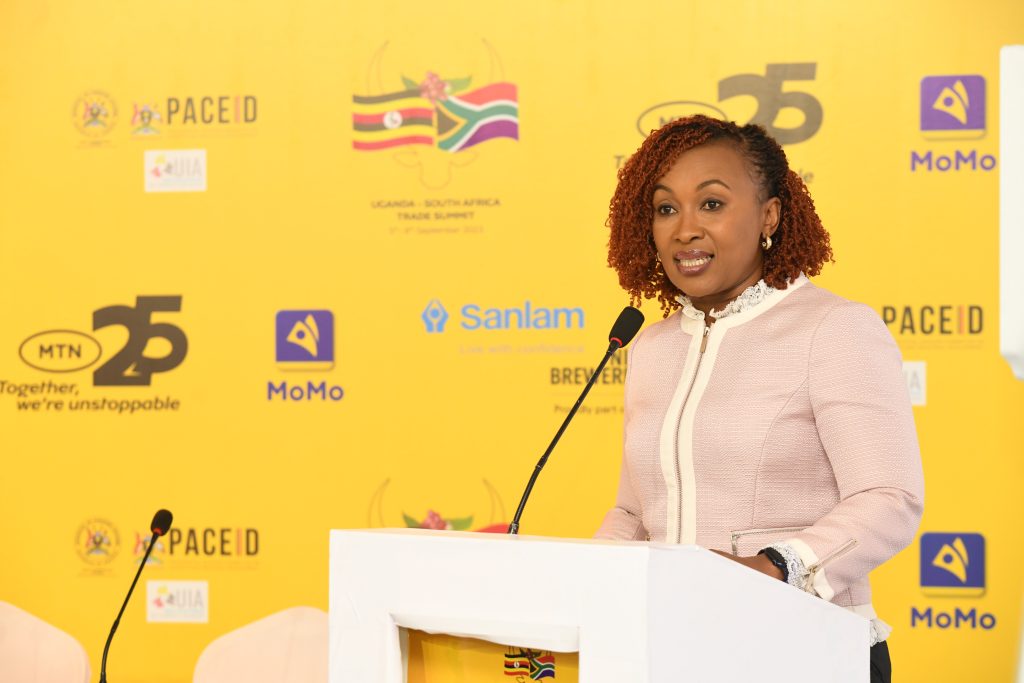
MTN Uganda CEO Sylvia Mulinge
MTN Uganda has reported a 16.1 percent growth in revenues to shs2.63 trillion for the year 2023.
Most of the revenues, (1.12 trillion) still came from voice services which grew by 11.6 percent, while the fastest growing segment was revenue from the use of data.
It maintained its position as the fastest-growing segment at 21.6 percent, returning a total of 621.9 billion shillings.
Voice revenue were boosted by the end-of-year festivities especially due to increased growth in voice traffic, as well as the optimisation of the bundle offering. During that specific period, growth shot up by 15.2 percent.
The other significant revenue source was Fintech (basically mobile money services) which fetched 771.6 billion shillings which is a growth of 17.6 percent.
Richard Yego, the Managing Director of MTN Mobile Money Uganda Limited said, “MTN MoMo Pay remains very paramount, it was one of our key focus areas of 2023.
The transaction value has more than doubled and this has led to increased revenue.”The company’s audited financial results show that profit after tax grew by 21.4 percent to 493 billion, and the company was able to pay dividends to shareholders, amounting to 403 billion shillings at 18 per share.
By the end of the year, MTN’s customer base had grown by 13.3 percent to 19.5 percent, according to the statements.
The share of voice as a contribution to total revenues continued to decline, going down to 42.5 percent compared to 44.2 percent in the previous year.
On the other hand, the high growth in data revenues was mainly due to improved smartphone penetration, which stood at 39.1 percent. The company says that most of the traffic (two-thirds) was carried on the 4G network up from half the previous year.
The company expects more growth in 2024 in line with the expected growth in the country’s GDP of 5 percent.
It also promises to achieve a geographical coverage of 90 percent of the country by 2025 as per the Nation Operators’ License provisions.
“One of our key milestones achieved in the year was the improvement of our network efficiency through the additional spectrum secured,” said Sylvia Mulinge, the Chief Executive Officer.
She also hoped that they would sell another 7 percent shares to the public this year.
UGANDANS WALLOW IN POVERTY
The growth can also be traced to MTN’s recently introduced measures to maximise profits and they are now paying off.
One of them was to do away with the annual MTN Kampala Marathon, a decision that has left many Ugandans cursing.
This event has been a money making avenue for Ugandans whenever it was held.
Talk of running kits makers and contractors, water and juice sellers, events management services (tents, music, stage etc), event’s advertising revenue going to media houses, winners’ cash prizes and among others.
And more so, money collected from this event has always funded various causes like bolstering and boosting maternal health, constructing or renovating schools, extending safe water and among others—all to the benefit of Ugandans.
This time, the bosses in South Africa and Ugandan tycoon Mbire (who reportedly has about one percent shareholding) also need the small money which MTN has been using to organize this marathon in terms of profits.
Insiders told us that MTN bosses must milk Ugandans at all costs and new MD Chief Executive Officer Sylvia Mulinge has been well briefed on this.
We have now learnt that in the grand scheme of things, scaling back on corporate social responsibility (CSR) initiatives where MTN has been injecting some of its revenue is one of the priorities—MTN Kampala marathon is the first casualty.
Uganda’s telecom sector observers opine that MTN is intentionally doing this because they feel they have done it all to capture the Ugandan market and hence no need of dishing out more freebies to customers to woo or retain them.
Since 2007, MTN has been dedicating a percentage of their profit to CSR through the MTN Foundation to extend hope to those in need. Call it giving back to the community. Focus has been to strategically improve 4 thematic areas that include Youth, Health, Education and ICT.
It is this giving back to the community or CSR initiatives budget that the bosses are targeting.
“Simply said, MTN has almost no competition. MTN is swimming in money. They want to keep it,” analysts opine stressing that this explains why MTN no longer sees a reason to continue big time things like the annual MTN marathon which can affect their profit margins.
This also further explains why MTN is no longer spending on advertising.
“Advertising revenues have been part of the give back to the community. But is now retained and repatriated as profits to the mother country,” analysts further observe.
Observers further stressed that MTN bosses stopped spending or investing anything in Uganda the moment they listed 22.4 billion ordinary shares on the Uganda Securities Exchange (USE), which gave Ugandans a sense of ownership whereas not as more than 80 percent of profits is repatriated.
Whereas, according watchers, Airtel Uganda would have forced MTN to increase its visibility through investing in local advertising, spending on CSR activities and among others, the former also no longer advertises big time because they are conformable being Number two.
“Most Ugandans if not all, atleast each of them has a second line in Airtel. If Airtel is not into big things, MTN will always scale back,” observes one of the industry analysts and adds: “If you have MTN and Airtel not spending and scooping profits back home it impacts the economy in the long run.”
This publication has learnt that this explains why the government is revamping Uganda Telecom to give the two bloody noses.
“There is a need for a third serious competitor in the industry. At the moment they are not under any pressure to spend but to repatriate profits only.”
We are told this is the same strategy being adopted by foreign banks like Stanbic, Standard chartered and others but this is a story for another day.
UGANDANS NOT HAPPY WITH TELECOMS
Whereas Ugandan Telecoms continue to swim in huge profits which foreign owners even repatriate back home, Ugandans are not happy. Ugandans feel these telecoms can do much more than deploying their PR machinery and CSRs to cover up. Members of Parliament have urged them to adopt more friendly data and voice bundles.
“This issue of expiry of data and voice bundles needs to be addressed. How do you tell me that bundles have expired? Technology has no expiry date. In many countries, one is only required to reactivate the bundle; it’s like money on your account where the bank tells you that your account has become dormant, it is then reactivated and you can access your money,” says Deputy Speaker Thomas Tayebwa.
MPs also want regulator UCC to direct telecom service providers to remove interconnection fees that have created unhealthy monopolistic tendencies, making it costly for subscribers to make calls across other networks.
Ugandans continue to pay heavily in their bid to access telecommunication services characterised by dropped calls, exorbitant rates on data bundles, unrealistic consumption patterns and expiry of internet bundles among others.
There are also issues to do with cyber security where unscrupulous people are swapping customer’s sim cards and using them for fraudulent and heinous acts. Many Ugandans especially MTN subscribers have lost huge sums of money on the hands of these people who collude with insiders.
Poor network especially both in and outside Kampala is also another challenge—both internet and calls. Dropped calls are the order of the day and yet they are charged, a matter minister Frank Tumwebaze has been lamenting about.
Ugandans are also not happy with Airtel’s unfriendly mobile money transactions. For instance it’s easier for MTN line owners to authorize mobile money withdrawals in favor of a recipient who is very far away from them than is the case with Airtel.
Some users also prefer using Airtel Money because of its favorable terms when it comes to borrowing –Quick loan and wewole for Airtel—compared to MTN’s Mokash, Mo-pesa and Mo-sente whose limit is ever low and with a lot of bureaucracy.
For Airtel Wewole they say even if repayment is delayed, they will not demand menacingly. Yet you can also keep using Airtel money for transactions. You can spend even a year and they won’t bother you.
“But for MTN hooo. They will deduct the money automatically once payment is due. If you don’t use MTN money, they will bombard you with messages and calls. They even threaten to reduce your loan limit on top of reporting you to the Credit Reference Bureau and being denied loan by other lenders. I have no kind words for them,” one user told this publication.
GOT A HOT STORY? CALL/TEXT/WHATSAPP-0777959024 or Email: Redpeppertips@gmail.com. With as much evidence as possible. Source protection/confidentiality is our NO.1 priority.
About Post Author