SHAME AT UGANDA EMBASSY IN MALAYSIA! Secret Probe Exposes Chaos, Missing Systems, Failed Activities As Betty Bigombe Team Faces Heat Over Shs8.6Bn Operations
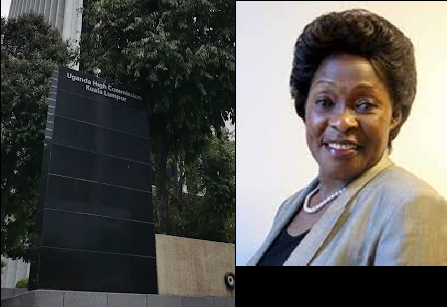
A fresh Auditor General’s report has blown the lid off shocking operational weaknesses, failed activities, planning gaps and accountability concerns at Uganda’s High Commission in Malaysia, exposing what critics are calling a diplomatic embarrassment under the watch of top embassy officials led by Ambassador Betty Oyella Bigombe.
The explosive findings covering the financial year ending December 2025 paint a disturbing picture of an embassy that consumed billions of taxpayers’ money while several critical activities either stalled completely, remained partially implemented or could not even be assessed due to missing targets and poor planning systems.
The Uganda High Commission in Kuala Lumpur, Malaysia, which is also accredited to Thailand and Vietnam, is headed by Ambassador Extraordinary and Plenipotentiary Dr. Betty Oyella Bigombe.
The diplomatic team at the mission includes Minister Counsellor Kasujja Moses Kalule, Third Secretary Everlyn Kasangaki, Financial Attaché Emmanuel Tugume and Administrative Attaché Jennifer Kyokutamba.
But despite the presence of the full diplomatic team, the Auditor General’s findings show glaring weaknesses in supervision, accountability, procurement management, strategic implementation and monitoring systems.
The report reveals that Parliament appropriated a massive UGX8.683 billion for the High Commission during the financial year 2024/25, all meant for recurrent expenditure.
Out of this money, UGX985 million was allocated to wages while UGX7.698 billion went to non-wage expenditure.
Shockingly, the mission absorbed and spent 100 percent of the funds released to it.
However, despite the complete consumption of the budget, auditors discovered alarming failures in implementation and accountability.
The Auditor General assessed outputs tied to the UGX8.683 billion expenditure and found that three major outputs could not even be assessed because the embassy lacked proper performance targets and indicators for all activities.
This meant auditors could not establish whether taxpayers’ money achieved the intended objectives.
Out of 32 planned activities at the mission, only four were fully implemented.
Five activities were only partially implemented while a staggering 13 activities could not be assessed at all due to absence of measurable targets.
The findings have now raised serious questions about what exactly embassy officials were doing with billions of shillings if activities could not even be tracked properly.
The report further exposes procurement irregularities after auditors discovered that the High Commission carried out procurements worth UGX132.4 million which were not included in the approved procurement plan for the year.
This means purchases and spending were undertaken outside officially approved plans, raising concerns about compliance and internal controls at the mission.
Auditors also uncovered shocking record keeping failures involving government assets and maintenance works.
The High Commission budgeted UGX37 million for maintenance of transport equipment, machinery and other equipment, and all the money was fully spent.
However, investigators found no maintenance logs documenting activities undertaken, costs incurred or personnel involved in the maintenance works.
The absence of maintenance records has now triggered fears that public funds may have been spent without proper accountability mechanisms.
Even more damaging, the audit established that assets acquired during the financial year lacked acquisition costs in the assets register.
This incomplete recording of assets could result in serious misstatements in the financial statements and raises concerns over the accuracy of government property records at the mission.
The report also reveals deep cracks in the embassy’s long-term planning systems.
Analysis of the Strategic Plan cost estimates and actual funding showed underfunding with a huge 44.5 percent variance affecting implementation of planned activities.
One of the major casualties of this funding mismatch was the proposed construction of the chancery which reportedly failed to take shape altogether.
The National Planning Authority assessment report added more embarrassment after rating the High Commission’s performance at only 61 percent compliance in delivering NDP III outputs through proper output indicators.
This means the mission fell short in effectively aligning its activities with Uganda’s broader national development agenda.
Auditors also discovered that the High Commission lacked an annualized Monitoring and Evaluation framework.
To make matters worse, there was no end-term review report for the Strategic Plan covering 2020/21 to 2024/25.
As a result, the embassy reportedly operated without a structured mechanism to track progress, assess performance or support timely decision-making.
The audit further assessed implementation of the ECD work plan and found that despite spending 100 percent of the ECD budget, the mission only managed to implement 56 percent of the planned 209 activities.
Only 117 activities were implemented, leaving nearly half of the planned work undone despite full budget utilization.
Auditors blamed part of the poor performance on the release of ECD funds before sensitization and training of staff, a move that negatively affected implementation and performance.
In another major governance gap, auditors found that the High Commission did not even have a Client Charter.
Without a Client Charter, the mission lacked a proper mechanism through which service delivery standards could be continuously monitored and evaluated.
The report also reopened old wounds after auditors reviewed Treasury Memoranda relating to previous Auditor General reports for financial years 2013/2014 to 2015/2016, 2021/2022 and 2022/2023.
Out of 29 recommendations previously issued, only 15 had been fully implemented.
Twelve recommendations were only partially implemented while two recommendations had not been implemented at all.
The findings now paint a picture of repeated audit concerns persisting year after year without full corrective action being taken.
The scandalous revelations are likely to pile fresh pressure on Ambassador Betty Bigombe and her entire diplomatic team as questions grow over management standards, accountability systems and supervision at one of Uganda’s key foreign missions in Asia.
Critics are now asking how an embassy can spend every coin allocated to it yet fail to fully implement activities, fail to maintain proper records, fail to track performance and fail to comply with several accountability requirements.
With taxpayers funding billions into Uganda’s foreign missions, the explosive Auditor General report has once again exposed the dangerous gap between expenditure and actual service delivery inside some of the country’s diplomatic offices abroad.
GOT A HOT STORY? EMAIL: redpeppertips@gmail.
SOURCE PROTECTION/CONFIDENTIALITY IS OUR NO.1 PRIORITY.
About Post Author