UBOS Report Reveals Widespread Labour Underutilization, Youth and Women Most Affected
By Evans Najuna
Kampala — A new Labour Market Survey by the Uganda Bureau of Statistics (UBOS) has revealed deep-rooted challenges in Uganda’s labour market, with millions of people either unemployed, underemployed, or unable to access available work opportunities.
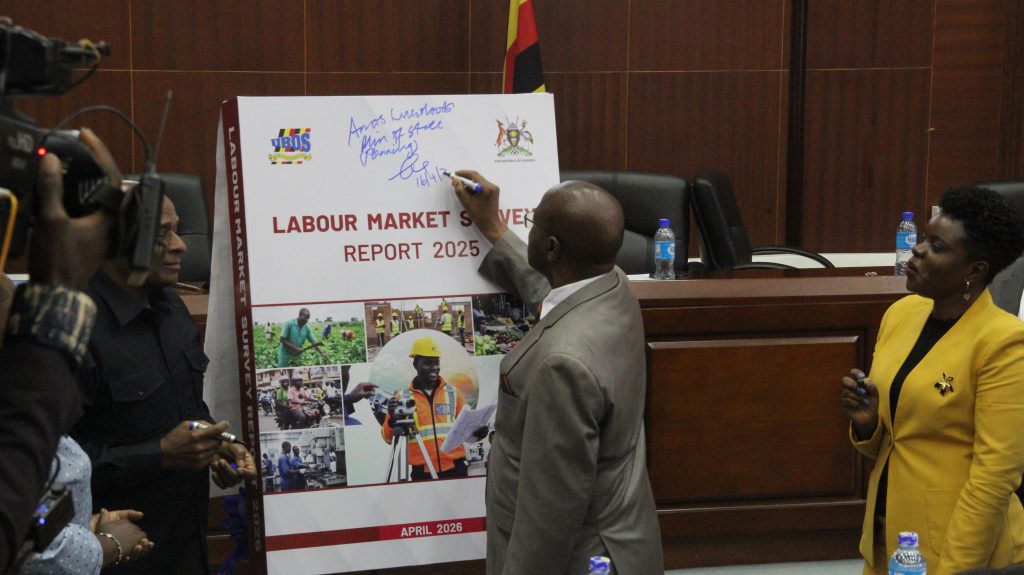
According to this 2025 Labour Market Survey report that was released on Thursday morning, the national Labour Underutilization Rate (LU4) stands at 41.6 percent—meaning that roughly two in every five Ugandans in the labour force are not fully engaged in productive work.
The findings show that women continue to bear the greatest burden, with 48.3 percent affected compared to 34.8 percent of men. Rural areas also recorded higher levels of labour underutilization at 43.9 percent, compared to 38.5 percent in urban centres.
The national unemployment rate was estimated at 12.2 percent, again higher among females (13.9 percent) than males (10.8 percent). Urban areas registered slightly higher unemployment levels (12.8 percent) than rural areas (11.8 percent).
Beyond outright unemployment, the report highlights a broader measure of labour distress. The combined rate of unemployment and time-related underemployment stood at 19.9 percent, indicating that about one in five Ugandans is either jobless or working fewer hours than desired. This burden was more pronounced among women (21.8 percent) than men (18.4 percent).
Young people emerged as the most affected demographic. Those aged 15–19 years recorded a combined rate of 27.4 percent, followed closely by the 20–24 age group at 26.1 percent—underscoring the persistent challenge of youth unemployment in the country.
Education levels also played a critical role. Individuals with post-primary specialized training and higher education had significantly better outcomes, with lower underutilization rates, while those with little or no education faced higher levels of unemployment and underemployment.
Regionally, stark disparities were observed. Sub-regions such as Teso (36.3 percent), Bukedi (30.6 percent), and Karamoja (27.6 percent) recorded the highest combined rates of unemployment and underemployment. In contrast, Ankole (13.4 percent), Kigezi (13.0 percent), and Bunyoro (15.0 percent) registered the lowest.
The survey further examined the “potential labour force”—people willing to work but unable to actively seek jobs due to various constraints. Nationally, 27.1 percent of Ugandans fall into this category, with women (34.0 percent) significantly more represented than men (20.1 percent).
Youth again dominated this category, particularly those aged 15–19 years (42.6 percent), highlighting a large pool of untapped labour.
When unemployment is combined with the potential labour force, the rate rises sharply to 36.0 percent nationally, with a pronounced gender gap—43.2 percent for females compared to 28.8 percent for males.
The report also sheds light on why many Ugandans are not actively seeking work despite being available. The leading reason is discouragement, cited by 46.1 percent of respondents. Family responsibilities and housework follow at 26.6 percent, disproportionately affecting women. Other factors such as illness, disability, pregnancy, and waiting for job feedback were less commonly reported.
At the regional level, the highest levels of discouraged workers were recorded in Bukedi, Busoga, and West Nile.
Overall, the findings paint a sobering picture of Uganda’s labour market, pointing to structural challenges in job creation, skills development, and workforce participation.
The Uganda Bureau of Statistics report underscores the urgent need for targeted interventions, particularly for women, youth, and rural populations, to unlock the country’s full labour potential and drive inclusive economic growth.
In his remarks, the State Minister for Finance in charge of Economic Planning, Amos Lugoloobi, noted that the report provides critical insights to guide job creation, skills development, and inclusive economic transformation in Uganda.
He explained that the government has already prioritized socio-economic transformation, with a strong focus on transitioning more Ugandans into the formal economy. He added that the presentation offers valuable insights into labour supply and demand, sectoral performance, and existing manpower gaps.
“As this transformation progresses, we expect to see a reduction in the size of the informal sector and an expansion of the formal sector,” Lugoloobi said.
He also commended the Uganda Bureau of Statistics for continuously strengthening a culture of evidence-based decision-making in the country.
He added that the findings further underscore the importance of ongoing government programmes aimed at transforming livelihoods, including initiatives such as the Parish Development Model.
About Post Author