IGAD States Discuss Regional Strategy to Counter Threat of IEDs
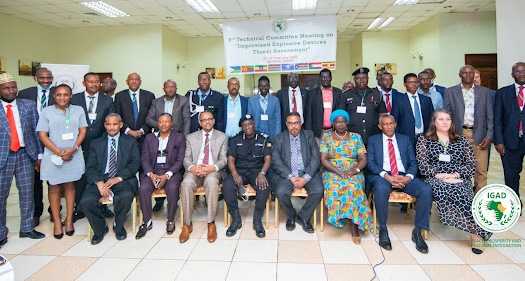
Representatives of IGAD Member states pose for a group photo during the 3rd Technical Committee Meeting
Kampala, Uganda; The Intergovernmental Authority for Development (IGAD) member states convened on Tuesday, 1st February, 2022 to discuss Development of a Regional Strategy to Prevent, Counter, and Respond to the Threat of Improvised Explosive Devices (IEDs) in the Region.
IEDs are weapons of choice for terrorist organizations globally, posing a threat to security forces, civilians, critical infrastructure and local systems of governance.

Speaking at the session held at Imperial Royale Hotel, Kampala, Commander Abebe Muleneh Beyene, the Director IGAD Security Sector Program (ISSP) said IEDs can be simple to design, and components remain cheap and easily accessible, including through criminal networks and porous borders, and as a result of corruption and poor ammunition stock management.
‘’ Groups such as Al Shabaab, Da’esh, and ADF have recruited extensive cadres, which can be trained to manufactures and use IEDs. Precisely because these groups often aim at any gatherings of civilians, the locations of their victims are widespread and it is almost impossible to predict whom they will be. Besides, terrorist groups have sometimes made enduring gains in territorial control, creating areas where sophisticated IED production facilities can go undetected for long periods of time. The financial and organizational powers of several of these groups allow their IEDs manufacturers to continually adapt CIED measures’’, Abebe said.

Closing the third Technical Committee meeting, Abebe said the purpose of creating and implementing a strategy is to build enduring and sustainable solutions to a highly evolving problem that has been ineffectively addressed through short-term train and equip efforts, most of which are costly, endless, and marginally effective.
‘’Strategic and operational levels of capacity building efforts have been largely neglected. This shortfall has resulted in countless iteration of training thousands of specialists and general-purpose forces. The incorporation of strategy development into capacity building will provide greater transparency for donor nations and accountability for partner nations. In this context, the IGAD SSP has initiated the development of comprehensive CIED strategy for IGAD Region in consultation with Member States to address the IED threat posed’’, he further asked member states to support and cooperate with IGAD SSP consultants to finalize the strategy that mitigate the existing threats posed by IED.
Cheap and relatively easy to construct, IEDs can be made anywhere from wide range of materials from everyday tools to commercial explosives used construction and mining.
On behalf of Uganda, Assistant Inspector General of Police (AIGP) Abas Byakagaba, the Director of Counter Terrorism the region needs a common strategy to encounter the threat of IEDs, sharing of information and experience.
‘’The presence here of IGAD member states is very crucial and it’s going to lead us to the next level. We have had a lot of successes in this area and we are getting on top of this situation’’, Byakagaba said.
He added that initially criminals used low explosive raw materials but now they graduated into the use of high explosives, adding that one of the ways of blocking these activities is people working together with security to identify the people involved in these activities.
‘’You may not go into the nitty-gritty of what is an explosive but suspicious activity, behaviors can lead you into counteracting these activities ‘’, he noted.
Her Excellency Madam Lucy Daxbacher, Head of Mission of IGAD for Uganda used this opportunity to state that the office of the IGAD mission had been opened in Uganda and it would be officially commissioned by the Ugandan Minister of Foreign affairs.
‘’After the existence of IGAD since 1996, that will be the first day in which the office of IGAD is opened in Uganda’’, she told participants.

Other officials present included Mohamed Hussein Ahmed from the Ministry of foreign affairs of Sudan, who doubles as Chairperson of IGAD and Engineer Mahboub Maalim, CEO of the Project.
It should be noted that the IGAD Security Sector Program (ISSP) is conducting a threat assessment in the region that will lead to development of a Comprehensive sub-regional C-IED strategy for IGAD Member States that will be coordinated with and contribute to the African Union’s planned adoption of continental strategy.
According to officials ,the regional strategy is to include an updated threat picture of IED-related drivers of conflict and instability as well ensure the most comprehensive and holistic approach to prevention and mitigation efforts by IGAD Member states and Troop Contributing Countries (TCCs) considering that individual countries and organizations have developed their own capacities in the development of Counter IED and IED Defeat international standards, the incorporation into peace keeping institutions (such as the East Africa Standby Force and regional Center of Excellence), and the adoption of Member States.
IGAD officials say the purpose of creating and implementing the regional strategy is to build enduring and sustainable solutions to a highly evolving problem that has been ineffectively addressed through short-term train and equip efforts, most of which are costly, endless, and marginally effective.
The development of the regional strategy is intended to: Provide a common analytical and operational picture upon which IGAD Member States can base decisions, Harmonize national policies, strategies and legal frameworks both within the sub- region, and in support of the Africa Union’s efforts to develop a continental strategy and Promote enhanced co-operation between Member States, including sharing intelligence for IED exploitation, network analysis and disruption; mutual legal assistance; and joint operations.
Other intentions include Reinforcing the value of regional Centers of Excellence such as the International Peace, Supporting Training Centres (IPSTC, Kenya), the Humanitarian Peace Support School (HPSS, Kenya), the Ethiopian Peace Support Training Centre (EPSTC, Ethiopia) and the IGAD Centre of Excellence for the Prevention and Countering of Violent Extremism (ICEPCVE, Djibouti) and also Establishing a modified platform for cooperation with regional and international partners.
Africa has suffered seriously from the scourge of IED use, with more than 1,200 incidents recorded across the continent between June 2018 and May 2019.
A continental strategy will provide clear and cohesive guidance on Regional Economic Communities’ (RECs) and Member States’ (MS) roles and responsibilities within their respective unique areas of capacities that meet both internal defense and peacekeeping mission requirements.
The Continental Strategy will establish guidance and focal points for Regional Economic Communities, Member States and development partners to synchronize capacity building efforts and manage resources, according to IGAD officials.
About Post Author