BUDGET CUTS! Who got what in first quarter?
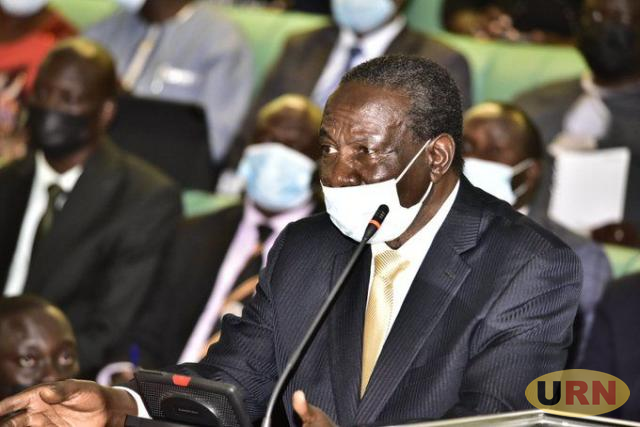
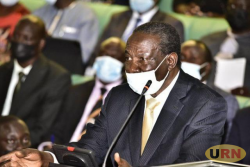
Matia Kasaija, the Minister of Finance, Planning and Economic Development
By our reporter
The Ministry of Finance only released development budgets for four government entities in the first quarter of the current financial year.
This newspaper has learnt that only the Ministry of Defence, State House, Ministry of Works and Uganda Revenue Authority (URA) benefited from the 596.7 billion Shillings development expenditure releases in the first quarter of financial year 2022/2023.
The first quarter of the financial year runs from July to September and this small development budget release partly explains why many government infrastructure projects have come to a standstill.
The revelation is carried in a detailed report to parliament’s Finance Committee by the Minister of State for Finance, Henry Musasizi explaining the underlying circumstances that informed budget cuts to Ministries, Departments and Agencies in the first quarter of the financial year.
Out of the 14.57 trillion Shillings that the Ministry was expected to release in the first quarter, only 10.25 trillion Shillings was released, creating a deficit of 4.3 trillion.
Now, out of the released 10.25 trillion, the bulk of 5.62 trillion went to debt and interest payment and the remaining 4.67 trillion was released for discretionary expenditure by Ministries, Departments and Agencies (MDAs).
A breakdown of the released funds shows that 1.603 trillion catered for wage, 1.813 trillion for non-wage, 596.7 billion for Development budget and 661.9 billion for arrears.
“There is a zero development release except for: Ministry of Defense, State House, Ministry of Works and URA equipment,” reads a document tabled before Minister Musasizi.
However, the document does not give the specific development budgets received by the entities except the Ministry of Works which got 26 billion.
“The Ministry is cognizant of the impact of the Quarter One releases on ongoing projects but borrowing additional resources to bridge the fiscal gap would have adverse social economic consequences. I therefore pray that you remain optimistic. When the macroeconomic fundamentals improve, the resources will be released as appropriate taking into consideration the revenue performance,” Musasizi appeals to the Finance Committee.
The document accessed also indicates that institutions were provided with 10% of the Quarter One work plan except for the Ministry of Defence, State House, URA, Parliament and Judiciary which received a full release.
Referral Hospitals, Mulago National Referral Hospital, Uganda Cancer Institute, Uganda Heart Institute, Uganda Blood Transfusion Services- UBTS, Missions Abroad, Universities, Ministry of Gender, Labour and Social Development (SAGE) received 80 percent of their non-wage budget for the first quarter.
The entities that received 50 percent of the non-wage budget are Police, Prisons, Internal Security Organization (ISO) and the External Security Organization (ESO), Local Governments and Kampala Capital City Authority (KCCA), all Commissions, Agriculture Institutions, Ministry of Education, Ministry of Health and others.
In the documents before the committee, Minister Musasizi says that the entire arrears allocation of 662 billion for the first quarter was released and 1.603 trillion for wages.
“Regarding Budget Support for this financial year, we have sought the advice of Cabinet and shall bring this to Parliament for approval very soon,” says Musasizi.
Before the current financial year started, Musasizi said the country was experiencing economic shocks like the increase in the prices of essential commodities and services which led to an increase in inflation from 2.7% in January 2022 to 6.8% in June 2022 and others.
He notes that the increase in prices was caused by the effect of Covid-19 restrictions across the world which disrupted supply chains, leading to high transport costs, a rapid rise in demand for fuel, raw materials and other goods when global economics were opened, and the Russian-Ukraine conflict.
“As a result of the economic shocks, the Ministry was faced with a challenge of maintaining macroeconomic stability through prudent liquidity management amidst low revenue performance. You will note that the government operates a cash based budget and executes the Budget quarterly,” reads part of Musasizi’s document to the Finance Committee.
He says that under normal circumstances, the Ministry would have mobilized the 4.3 trillion first quarter shortfall through borrowing.
He however said that this could not happen since the economy was faced with increasing costs of domestic borrowing, contravention of the structural benchmarks and quantitative assessment criterion which was agreed with the International Monetary Fund –IMF and the subdued aggregate consumer demand which may have an impact on the revenue forecast.
Parliament approved a total budget of 48.1 trillion Shillings for the financial year 2022/2023 and out of this, 17 trillion is for interest and debt repayment.
The budget was envisaged to be financed through revenue collections of 25.7 trillion, grants 2.1 trillion and domestic borrowing 7.1 trillion.
The Finance Committee meeting with Ministry officials on Tuesday ended prematurely due to a section of unreadable documents submitted and the committee Chairperson, Keffa Kiwanuka adjourned it to Thursday. The meeting will discuss the specific budget given to each government entity in the first quarter vis-à-vis the appropriated funds, money paid for debt, effects of the budget cuts and others.
The process in the committee follows a directive by Speaker of Parliament Anita Among to investigate the budget cuts and report back to parliament.
GOV’T SETS DATES FOR BUDGETARY FUNDING
Meanwhile, the Government through the Ministry of Finance will by the end of this year release funds required to fully cover the budgetary shortfalls currently afflicting all Ministries, Departments and Agencies. According to Hajji Yunus Kakande, the Permanent Secretary Office of the President, this is in a bid to aid implementation of government programmes which has stalled amidst the current financial squeeze.
Kakande made the revelation while addressing a consultative meeting which was convened at the Office of the President Conference Hall by the Manifesto Implementation Unit (MIU) of the Office of the President to mainstream and evaluate the 2021-26 Manifesto commitments in the various MDAs.
Addressing representatives drawn from various MDAs across the country who were invited for the strategic manifesto implementation meeting, Kakande revealed that the government is fully aware of the current challenges in implementing the manifesto but plans to fully close the funding gaps have been finalized.
“Government is aware that the various MDAs got only 8% of their budgetary allocations. But that was partly due to bad cash flows occasioned by unforeseen shocks like the Covid-19 pandemic and the Russia-Ukraine war. However, in a recent cabinet meeting it was resolved that by the end of the year all MDAs will have got their full budgetary allocations,” Hajji Kakande said.
Kakande allayed general fears of lack of funds in the national treasury by revealing that apart from the economic shocks, the government also deliberately withheld some money so as to control inflation.
Kakande thus urged all manifesto implementation stakeholders to ready themselves for full programmes implementation in line with new policy guidelines, most notably the programme-based budgeting and adherence to the 23 strategic guidelines issued by the president as a basis for effective manifesto implementation and diligent pro-people service delivery in this political term.
“All money will be received by the end of the second quarter, so there will be no room for excuses in case anyone fails to implement any government programme,” Kakande said.
He hailed the MIU for convening the consultative meeting, saying it is important in planning and budgeting; especially given the government’s shift from sectoral working groups to programme-based budgeting and reporting.
Kakande further commended MIU led by director Willis Bashaasha for constantly engaging manifesto implementation stakeholders, which he says has enabled implementation of some of the 23 strategic guidelines which were first initiated and communicated by the president at Kyankwanzi in 2016.
He however, appealed to the programme secretariat heads who attended the meeting to be keen on the programmes’ implementation, noting that fulfilling the NRM government’s social contract to the people is the only sure way to win reelection in 2026.
“We are happy that some work has been done regarding implementing the 23 strategic guidelines. You should however always remind yourselves that once all MDAs implement the current manifesto based on those guidelines within the remaining period of this current term, then the citizens will be satisfied and will unreservedly give the government a new mandate come 2026,” Hajji Kakande said.
Kakande lauded the framers of the NRM manifesto 2021-26, calling it an attainable goal due to its being aligned with all government planning tools like the National Development Plan (NDP) III which further ties into Vision 2040. He noted that such alignment enables honest and frugal spending unlike previous NDPs which were overly ambitious with some unattainable programmes.
Addressing participants, Willis Bashaasha, the Director MIU noted that they decided to invite the secretariat heads so as to achieve harmonization in reporting of the implementation of government programmes so as to achieve coherence in knowledge of the extent of manifesto implementation.
“Government has adopted programme-based budgeting and so the NDP III equally requires a programme-based approach to reporting. Because of the migration from the sectoral-based approach to the new reporting mechanism, we invited the programme secretariat heads at the various MDAs to agree on the monitoring and evaluation of government programmes as well as the new reporting mechanism,” Bashaasha said.
He noted that following fruitful deliberations in the Tuesday meeting, a follow-up meeting will be convened in October during the second quarter to assess the progress of the performance of the manifesto as well as the reporting framework.
<<<<<<<<<<<<<< <<<<<<<<<<<<<<<<<<<
GOT A HOT STORY? CALL/TEXT/WHATSAPP 0777959024 OR EMAIL redpeppertips@gmail.com
About Post Author