Eight Ministers face knife over Kinyara–Victoria Sugar war
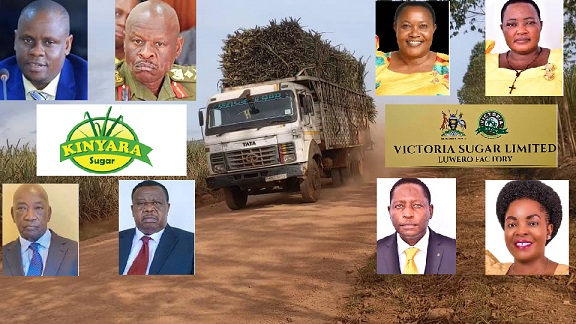
Eight ministers may face the knife over the raging Kinyara Sugar Limited and Victoria Sugar war, a battle of World War II magnitude that has rocked the sugar sector and left political heavyweights bruised, exposed, and fighting for survival as a looming cabinet reshuffle casts a long shadow over their futures.
The fight, which has pitted powerful sugar interests against desperate out-growers, is no longer just about cane—it is about political careers hanging in the balance. Though Victoria Sugar reportedly hides behind the sugarcane out-growers, sources say the fallout from this conflict may sink over eight ministers, with their chances of bouncing back to Cabinet now tied directly to how this saga unfolds.
For years, farmers have been locked out, frustrated, and blocked from accessing the President. But during last elections campaign trail, they seized their moment, tipping him off on the crisis and vowing to expose what they described as dirty games orchestrated by his own policymakers.
At the center of the storm are many fronts/ Lets beging with .,Masindi, the epicenter of fierce cane wars between the two giants. Balaam Barugahara, the minister from the region, initially appeared ready to fight for the farmers and Victoria Sugar Limited. Upon ascending to office, he tried to push for justice, but somewhere along the way, he “ran out of gas” and abandoned the disadvantaged, leaving them stranded in deep waters.
The farmers then turned to Minister for the Presidency Milly Babalanda, laying bare their grievances. She reportedly promised action, signaling hope for a breakthrough. But that hope was short-lived. Within days, she was allegedly warned to back off if she still had ambitions of growing her political career.
Prime Minister Robinah Nabbanja also stepped into the fray at one point, reopening closed weighbridges in Masindi that had left farmers stranded and counting losses. For a moment, it looked like relief had arrived. But the fire that came from the giant sugar factory proved too intense. Faced with mounting pressure, Nabbanja stepped back, leaving the status quo intact after the matter began to threaten her political footing in the region.
With political players effectively neutralized, the management at Kinyara Sugar Works allegedly moved swiftly to entrench their position, seeking to legalise what critics describe as an illegality through the Ministry of Trade, Industry and Cooperatives.
Early last year, Kinyara management, working through their henchmen and Masindi security bosses, reportedly cajoled Trade Minister Francis Mwebesa to close roadside weighbridges, arguing they had become channels for stolen produce. This came after the minister convened meetings with stakeholders to understand the conflict and find solutions.
The first meeting collapsed. The second, dominated by Kinyara’s lawyers, Masindi leaders, and security bosses, concluded that out-growers had no strong grounds to maintain the weighbridges in Masindi Municipality.
What followed was decisive and controversial.
The minister issued a directive to close weighbridges in Bikonzi Sub-county, Bujenje County, and Kihande–Mile 2 in Masindi Municipality, citing security concerns. The move triggered outrage, forcing the Bunyoro Sugarcane Union to drag the government to court. But even with the matter pending, farmers say nothing has changed—they remain trapped in what they call relentless exploitation.
A year later, pressure from Masindi sugarcane growers intensified, forcing those behind the weighbridge closures to escalate the fight. In a dramatic twist, they dragged President Museveni’s blue-eyed boy, Gen Wilson Mbadi Mbasu, into the conflict despite the ongoing court proceedings.
Early last month, Gen Mbadi chaired a high-stakes stakeholders meeting at the ministry to chart a way forward. While the outcomes reportedly pleased the architects of the weighbridge closures, farmers were left furious, still demanding direct intervention from the President.
The meeting came after another powerful push—this time involving a letter from Internal Affairs Minister Kahinda Otafiire, which backed the closure of roadside weighbridges by linking them to sugarcane theft.
On the ground in Masindi, the situation remains explosive.
The long-running dispute is fundamentally about control—Kinyara’s struggle to maintain dominance over cane supply in the region versus farmers demanding freedom to sell to alternative buyers. Growers accuse Kinyara of forcing them into unfavorable contracts and sustaining a monopoly they describe as exploitation of the highest order.
Protests have erupted repeatedly, only to be met with force. Farmers claim demonstrations have been violently suppressed by police and plain-clothed operatives suspected to be UPDF soldiers, operating under regional security command. There are also claims that Kinyara management finances covert operations aimed at silencing dissent and forcing farmers to sell cane exclusively to them.
Despite turning to the courts, farmers insist justice has been slow and elusive, and their cries are now directed squarely at the President.
But the crisis is no longer confined to Masindi.
The weighbridge wars have spread to Busoga, pulling in more ministers and deepening the political fallout. Names like David Bahati, Persis Namuganza, and Evelyn Anite have now entered the fray, while Speaker Anita Among has also been petitioned—setting the stage for a high-level clash with Prime Minister Nabbanja.
As the scandal widens, the stakes grow higher.
Behind closed doors, whispers are growing louder about who did what, who benefited, and whose “beak has been oiled” in this high-stakes sugar war as we shall reveal in our subsequent publication.
And with a cabinet reshuffle looming, one thing is becoming painfully clear:
This is no longer just a fight over sugarcane.
It is a brutal political+ battlefield—and not everyone will survive it.
GOT A HOT STORY? EMAIL: redpeppertips@gmail.
SOURCE PROTECTION/CONFIDENTIALITY IS OUR NO.1 PRIORITY.
About Post Author