EXPOSING THE LIE: NMG troubles and why nobody loves the media
By Robert Atuhairwe
A hard but honest fact is that the concern around the shutdown of Nation Media Group (NMG) platforms is pretentious and dishonest.
Given what has been threatening the media over time, you get this sense that the solidarity with NMG is not heartfelt but all about CDF, Gen. Muhoozi Kainerugaba and by default, President Yoweri Museveni. You can smell “political” motivations from afar.
Why?
Nobody genuinely cares for the media. It’s one industry that is constantly under attack from all sides. Today it may be the state having issue with NMG but every single day if you follow these media platforms online you will be blinded by the attacks that media houses and their staff face from diverse audiences.
Everybody wants the media to do their bidding lest they are bundled off as sellouts or cheap or paid enemies. Nobody wants the plain picture. The biggest threat to media work is not state crackdown but opportunists who only think about the media when there is something they want to push through for themselves.
The politicians showing concern now are taking the stance because they see Monitor, NTV as their mouthpiece. Others are paid activists doing accountability for themselves but who are not honest enough to tell their benefactors that the biggest threat to media practice is less about lack of freedom to maintain a preferred editorial direction or to challenge power but economic factors that could see those media houses cease to exist tomorrow.
For some time now, NMG and media houses in general have been wrestling with the ghosts of other once vibrant stations that collapsed badly as economic shocks ravage their businesses. Mainstream media has been on “life support” since Covid-19 time.
Since that time, media practice has never been the same again yet the public’s expectations have never changed. Most stations have had to downside their operations, cutting down on personnel and products on the market. Vision Group, the company behind New Vision newspaper, Bukedde newspaper, Bukedde TV, Etop radio, etc, is no longer the Vision of its heyday pre-2019.
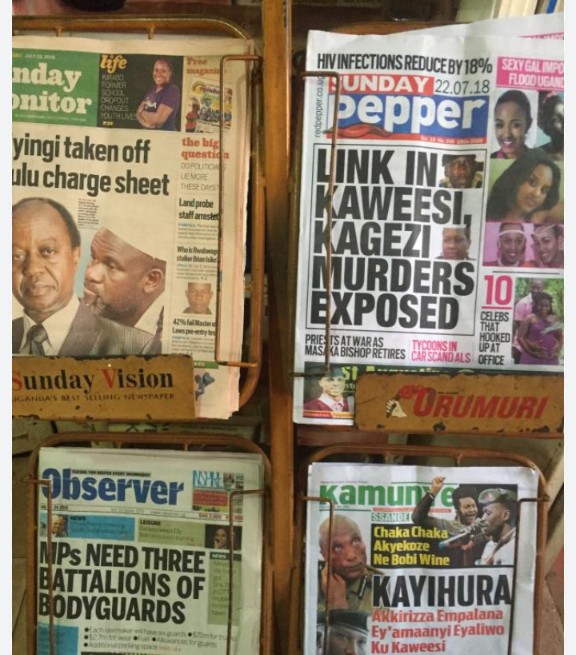
Observer, a once triweekly paper, is now weekly, but sometimes doesn’t publish at all. Red Pepper was a daily (with several brands under it including Hello, Kamunye, Entatsi) but now comes out once in a long while.
The Independent magazine of none other than the influential Andrew Mwenda is no more. Its authoritative brand folded while everyone looked on while celebrating its founder as an icon of investigative journalism and indefatigably courageous current affairs analyst, speaker of truth and vocal pusher for accountability.
Sunday Vision is no more, Sunday Monitor is no more. Bukedde ku Ssande (Bukedde on Sunday) is no more. All these titles were shut down as the parent companies cut costs to try and stall the aforementioned total collapse.
Every other media house, print and electronic is struggling. These groups now leading the cry over the NMG clampdown, were they present when the titles mentioned were folding? What was their reaction and what did they do? Nothing at all?! There has been no attempt that I know of to support these stations in real economic terms, like capital injection or investment to keep them afloat.
No journalists’ unions came out to voice their concern and appeal for real intervention (to bring back the titles). Circulation figures reveal that Ugandans are not supporting newspapers to thrive and do excellent journalism by buying them. (Details are secret, but seriously appalling). No one should be surprised if next they stop publishing the consolidated weekend papers (Saturday and Sunday vision combined), then stop publishing on some of the week days and then close business entirely.
It baffles that major media houses that we grew up seeing like permanent features, employing many Ugandans and paying taxes can crumble and there is no urgency to find a way to support them. What’s more, Observer, Red Pepper, The Independent are owned by Ugandans but no one seems to cherish the advantage of having indigenously- founded and locally run media spaces.
UBC is always chronically underfunded but people are quiet because some look at it as a state project that they associate with NRM, hence wishing that it’s starved of resources that it could use to run smoothly and provide balanced coverage. The very people accusing the state of being hard on their preferred networks are the ones opposing budget requests to improve UBC’s operations.
How different are they? NBS is constantly under attack by audiences that accuse it of being pro-the state. But when you ask them how much support they contribute in terms of revenue to enable the station expand its coverage, nothing!
They demand total editorial independence without feeding the cows!In the public sector, whenever cost cutting measures are considered, among the first items to get the chop is advertising/publicity and media expenditure.
How can that even make sense? How can a country that is progressing very fast and with stories to tell about its growth trajectory, needing to speak to its populace and potential foreign partners and investors elect to “muzzle” its press?
Yes! There is a problem of “too much politics”, gossip and FAKE news but that is a consequence of absence of support to cover substantive and transformative news and information. When media houses lack the means to do research and cover “hard” news, they resort to sensational coverage to attract audiences that are obsessed with fast, “unverified” news as on social media.
From there we end up in an NMG like situation. Cutting advertising revenue may seem like a bright idea but it’s an indirect way of killing the free press and “assassinating” the private sector. Money spent on the media is an investment. It always comes back in a cycle.
The workers in these media houses are our own Ugandans who spend within the very same economy that we seek to expand and create more jobs. The media promotes and showcases local products, brands, services and opportunities which would otherwise be unknown.
Buyers increase, producers make more money, Finance collects more tax and the cycle continues, and the economy expands. During the general elections, I looked at the manifestos of different political parties but was shocked that I didn’t see any mention of underwriting the media sector. Should industry players read deeper into that indirect message?
Bloggers and promoters, and some other groups have recently got billions. Well, good, but how can mainstream media houses not be given similar consideration? Hopefully, nobody thinks that mainstream media can be substituted with “sniper” bloggers and social media as sources of accurate and “cross checkable” news and information.
I wish to look into the eyes of anyone who thinks like that. So, a lot of these people condemning NMG’s closure don’t really care for the media industry’s survival and success unless we see them advocating for real value-addition, support, partnership and investment that keeps media business viable and sustainable.
The fourth estate cannot be a wagon for ferrying everyone else to their destination as it creaks and crumbles under their weight. Something REAL must be done and seen to be done!
The writer is a promoter of African Integration and CEO Friends of the Media International
About Post Author