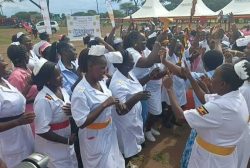
INTERNS’ CASH AXE! Health Ministry Under Fire Over Shocking Plan to Scrap Medical Intern Allowances

Health Minister-designate Dr. Chris Baryomunsi has defended the move to scrap allowances for medical interns and the reclassification of the internship as part of academic training rather than employment.
The move, which takes effect in July 2026 under the National Education and Training Health Policy, has triggered criticism from a section of Ugandans, especially those in the medical fraternity.
Baryomunsi explained in a phone interview with URN that the longstanding practice of paying medical interns had “become increasingly difficult to sustain as the number of graduates continues to rise.” “There are now many training institutions and universities that produce doctors. The question has been, whom do you pay?” he asked.
He noted that the Cabinet concluded that an internship should be treated as a continuation of professional training rather than formal employment.
“When you finish an internship, that is when you can get into full employment as a qualified doctor,” he said.
He acknowledged that the policy carries both advantages and disadvantages and may require adjustments during implementation.
The strongest resistance has emerged from the Uganda Medical Association (UMA), whose leadership has rejected the policy outright.
UMA President Dr. Frank Asiimwe described the proposal as “dead on arrival” and warned that it could undermine both medical training and patient care.
Uganda Medical Association argues that interns manage 60-80% of hospital workloads and deserve pay, especially when parliament’s budget doubled to 1.2 trillion shillings while health funding fell.
The internship year serves as a mandatory requirement for full registration by the Uganda Medical and Dental Practitioners Council and other professional councils governing health workers.
Uganda now trains doctors through numerous public and private institutions, including Makerere University College of Health Sciences, Mbarara University of Science and Technology, Gulu University, Busitema University, and several private universities.
The result has been a dramatic increase in graduates entering the internship pipeline, creating pressure on both training facilities and government finances.
Many newly qualified doctors emerge from university with substantial educational costs and family obligations. The dispute is likely to raise legal and policy questions regarding the employment status of interns, labour protections, and the government’s obligations under existing health workforce frameworks.
While government reports consistently identify shortages of doctors, nurses, and other health professionals, thousands of qualified graduates struggle to secure positions within the public service.
Baryomunsi acknowledged this contradiction during his remarks, promising to prioritize the recruitment and deployment of health workers across the country.
His comments align with objectives contained in the National Development Plan IV and the Health Sector Development Programme, both of which emphasize strengthening human resources for health as a cornerstone of improving healthcare access.
GOT A HOT STORY? EMAIL: redpeppertips@gmail.
SOURCE PROTECTION/CONFIDENTIALITY IS OUR NO.1 PRIORITY.
About Post Author