MONSTER CAGED! Ggaba Toddler Butcher Okello Sentenced to Death— ‘No Remorse, No Mercy’ As Court Condemns Child Killer
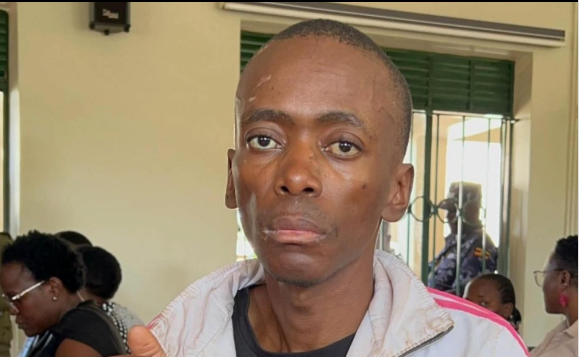
Monster Okello
There was no sympathy, no soft landing, and no escape as the High Court in Kampala delivered its most crushing verdict yet, sentencing child killer Christopher Okello Onyum to death for the brutal slaughter of four innocent toddlers in a case that has horrified the nation and scarred the Ggaba community forever.
Inside a tense courtroom heavy with grief and expectation, Justice Alice Komuhangi Khaukha made it clear that this was no ordinary crime. This was evil in its rawest form. A calculated, cold-blooded attack on the most vulnerable members of society — children who had been left in the safety of an early childhood development centre, only to be butchered in broad daylight.
The judge did not mince her words.
She ruled that the offence fell squarely in the “rarest of the rare” category, a level of brutality so extreme that only the maximum sentence under Ugandan law could suffice. While sentencing guidelines typically start at 35 years for murder, this case shattered all thresholds.
This was not just murder. It was calculated cruelty.
Court heard how Onyum meticulously planned his actions, deliberately targeting defenceless toddlers who depended entirely on adults for protection. Instead, they met a man who showed them none.
“They were slaughtered without regard for human life,” the judge declared, her words echoing through a silent courtroom.
Even more chilling was the convict’s conduct throughout the trial. Not once did he show remorse. Not once did he apologise. Not even as grieving families sat just metres away, reliving the horror of losing their children in the most senseless way imaginable.
“I expected him to show remorse… but he did not,” Justice Komuhangi said, visibly unmoved by any attempt at mitigation.
The prosecution had pushed hard for the death sentence, arguing that the murders were not only brutal but premeditated and possibly linked to ritual motives — a claim the court said could not be ignored, especially after expert testimony pointed to disturbing behavioural patterns.
In a last-ditch effort, the defence pointed to Onyum’s troubled upbringing, describing a life shaped by a dysfunctional family. But the judge swiftly dismissed it as irrelevant in the face of such monstrous acts.
“A broken background is not a license to slaughter innocent children,” she ruled firmly.
Then came the final blow.
“I hereby sentence you to suffer death,” she pronounced, listing each of the young victims — Gideon Eteku, Keisha Agenorwoth Otim, Ignatius Sseruyange, and Ryan Odeke — names that have now become symbols of a tragedy Uganda will not forget.
Outside the courtroom, emotions erupted. Members of the Ggaba community, who have lived under the shadow of this horror, broke into chants, some even dancing as the weight of justice finally settled in. For them, this was more than a sentence — it was a long-awaited moment of closure.
But the pain remains.
The case has sparked nationwide outrage, reigniting urgent calls for stronger protections for children and tougher action against violent crime, especially acts suspected to be linked to ritual practices.
Perhaps most disturbing were revelations that Onyum had searched online for violent extremist content, including beheadings, and had scouted locations with young children. While no clear political or religious motive was established, the pattern painted a deeply unsettling picture of intent.
Despite the verdict, the legal door is not fully closed. Onyum has 14 days to appeal both his conviction and sentence.
But for now, the message from the court is loud and unmistakable.
Uganda will not tolerate the slaughter of its children.
And for one man, the reckoning has finally come.
If an appeal is filed, lost, and the conviction is upheld by the Supreme Court, will Okello be hanged? The decision to hang rests on President Museveni and the nation awaits.
Uganda still retains the death penalty in its laws, and it is not abolished.
President Museveni has repeatedly stated his intention to resume signing death warrants for convicts on death row, particularly those who commit heinous murders, to deter rising violent crimes.
Under Article 22(1) of the Ugandan Constitution, the death sentence can only be executed once the conviction and sentence have been confirmed by the highest appellate court. If an appeal is lost, the sentence is confirmed.
The President has recently supported a “proportional justice” approach, aligning with an “eye-for-an-eye” mentality, rejecting leniency for murderers.
According to the Supreme Court ruling, if the highest court confirms a death sentence, the Executive has a period within which to exercise the Presidential Prerogative of Mercy. If the president does not act within a three-year timeframe, the sentence is typically commuted to life imprisonment.
About Post Author