PANIC! Mega reshuffle looms at URA as M7 consults Kagina
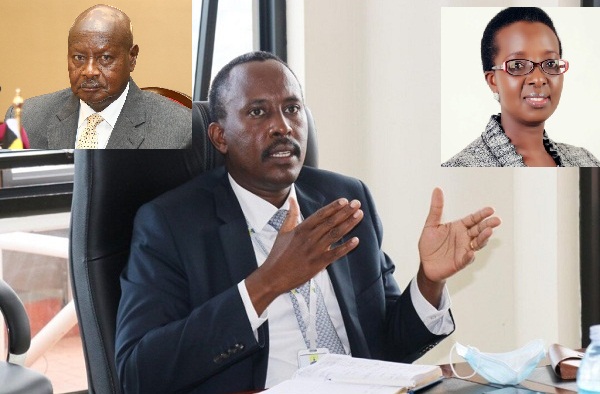
When President Museveni replaced Allen Kagina with Dorris Akol as Commissioner General of Uganda Revenue Authority in 2014, he hoped he had got the best cadre to do wonders as far as tax collection is concerned which would result in smooth running of the government programs through budgetary support.
Akol was given a benefit of doubt until 2020 when Gen Museveni decided enough was enough and brought in workaholic and energetic John Musinguzi Rujoki.
The purge which Gen Museveni even boasted about did not only stop at Akol, but also other URA senior officials would follow.
These included Dicksons Kateshumbwa, then head of domestic taxes, Henry Saka, from domestic taxes, Silajji Kanyesigye, the commissioner in the large taxpayer’s office and Samuel Kahima, a manager in charge of rulings and interpretations.
All has been seeming well at URA with Rujoki in charge, but the latest developments project otherwise.
Actually, if you take the temperature of how several staffers are feeling at the moment, the scale would likely read “uneasy.”
They have good reason to feel anxious.
Why? Recently, Gen Museveni summoned his blue eyed lady, Allen Kagina for a discussion and sources say key on the agenda was ‘the state of affairs at URA’.
We are reliably told that at the end of the meeting, Gen Museveni reportedly inquired if Kagina was available for redeployment at URA given that her UNRA is being disbanded very soon.
She reportedly thanked him for the trust in her but made it clear that she won’t be available. Nevertheless, she suggested some names which we shall be revealing in our subsequent publication.
Truth to be told, Gen Museveni has always trusted the great women he positions to help him serve Ugandans.
And he has never stopped thanking Kagina for how she turned around URA. And thus, up-to-date, even when she is out, he consults her here and then.
This explains why those who read between the lines at URA are anxious to an extent that they have started preparing psychologically and physically for the impending reshuffle.
Because of her honesty, we are told Kagina is being lined up for something else bigger not later than July this year.
It is not clear why Gen Museveni has lately developed cold feet towards the Rujoki-URA led administration but some of the details we have gathered so far will be in our subsequent publication.
However, it goes without mention that Gen Museveni has always been lamenting about Uganda’s tax-to-GDP ratio which is at 13 percent, currently, and the lowest in Africa. There are also reports of Shs2.5trillion shortfall in the last two quarters-between June and December 2022. Watch this space!
HERE’S URA’S 2023 REVENUE COLLECTIONS GAME PLAN
Meanwhile, on a good note, URA has come out to give a hint on how it intends to collect more revenue in the year 2023 .
While the revenue collections by URA have grown steadily over time, save for the COVID-19 pandemic period where there was a decline, the amounts collected, relative to the value of the economy, have remained stagnant.
The Domestic Revenue Mobilisation Strategy launched in 2019/2020 and running to 2023/2024 sets a target of increasing revenue collection to at least 16 shillings for every 100 shillings made by the country.
The Ministry of Finance, Planning and Economic Development now says the achievable target is increasing the ratio by 0.5 percent per year over the next five years.
This will require new efforts to widen the tax base, and going for artistes is part of them. Under the arrangement, URA directed all people in the public entertainment business like artistes, performers, DJs, VJs, authors, producers, promoters, comedians, bar owners, hotels, event managers, recreational space owners, bar owners and hotels owners to get Tax Identification Numbers (TINs), to facilitate tax collection.
A three million Shilling penalty or a jail term will apply to those who fail to comply, according to the tax body.
Taxes that are charged on the industry include withholding tax by event holders deducted from the performer, value-added tax and income or corporation tax payable by the artist.
However, most of them have not been paying the tax due to the informal nature of the sector.
The easiest way for URA was to camp at the entrance of the concert venue and note the number of people entering, then charge the tax according to the estimated revenue.
A number of people in the industry have said they are ready to pay the tax provided the rates will be ‘within acceptable levels’, while others call for sensitisation on the whole taxation business especially the different tax categories and when they are supposed to be paid.
Crispus Mugabi, from the Medium Taxpayers office, explains that an event organizer is a primary person in regard to payment of taxes.
However, the performer, according to Domestic Tax Officer Samuel Mukobe, also has obligations to pay taxes at the end of the day because they also generate income for themselves.
URA Commissioner General, John Rujoki Musinguzi said URA has listened to different submissions and concerns and is ready to keep negotiating and sensitizing the public on this development.
“It is important that we recognize that it is a civic duty for every eligible income earner to contribute their fair share of tax towards the development of our country. We value good stakeholder relations and we are lined up to engage this sector to understand and appreciate everyone’s role in our nation’s journey to self-reliance,” said CG Musinguzi.
The promoter’s association on Wednesday morning commenced the negotiations with URA, according to a brief statement issued after the first meeting.
URA says a TIN number will help in monitoring the compliance of the taxpayers and also include those that have not been paying, so as to ensure more people are in the taxpayer net. At least 147,892 new taxpayers were added to the taxpayer register during the quarter from July to September 2022, representing a growth of 5.65 per cent, and bringing the total number to 2,765,900 taxpayers. Of these, 174,020 are non-individuals like companies, NGOs and agencies.
“This means there are very few Ugandans contributing to the tax basket, yet our expectations are high, hence the need to expand the tax base so that we bring more Ugandans to contribute to national development,” says Ibrahim Bbosa, the Assistant Commissioner, Public and Corporate Affairs at URA. He reasons that there is no developed country in the world collecting taxes at a rate of less than 20 per cent of GDP.
The Commissioner General says URA wants to have at least five million taxpayers on the register by 2024/2025 if tax revenues are to help boost economic growth.
One of the measures they have put in to enhance sensitization is the introduction of the mobile tax office dubbed ‘Tujenge (Let’s Build) Bus’, which features the URA bus going to remote and other hard-to-reach areas.
“We have also increased the number of tax offices to the major towns, and one-stop shops to 44 to take our services closer to the people,” he says in a statement to taxpayers this year.
The last year has seen an improvement in revenue collections as the country’s economy continued to recover from the effects of the COVID-19 pandemic which were at their worst in 2020 and earlier 2021.
In the Quarter to September 30, 2022, URA surpassed its 5.132 trillion-Shilling target to collect 5.418 trillion Shillings. This was also 21.5 per cent higher than what was collected in the same period of the previous year.
The recovery was however threatened by the sharp rise in inflation rates in Uganda and globally mainly driven by high fuel prices, especially in the second and third quarters of the year.
Sarah Chelangat, URA Commissioner of Domestic Taxes, one of the main achievements in the last year has been to simplify the process of acquiring the TIN which is now a mandatory requirement. URA rolled out the instant TIN, a web-based TIN application procedure and in turn removed the tedious complicated processes that usually resulted in errors by taxpayers.
“These complications forced many clients to resort to the tax agents and internet cafes for help which charged exorbitant fees, and for those who could not afford, acquiring a TIN became long, tedious and sometimes intolerable,” says Chelangat.
Currently, a taxpayer only needs a National ID or, for companies, a Certificate of Incorporation and access the URA web portal for the services which can take five minutes, according to her. URA has also made efforts to ease the return filing procedures through the web-based return template for presumptive business taxpayers, or those whose turnover does not exceed 150 million Shillings a year. DO YOU HAVE A HOT STORY (CHEATERS, DIVORCE, VIDEOS, CORRUPTION, LAND WRANGLES, EXPOSES …ETAL) YOU WOULD LIKE US TO PUBLISH? CALL/TEXT/WHATSAPP 0777959024 OR EMAIL:redpeppertips@gmail.com
About Post Author