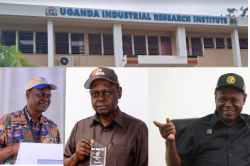
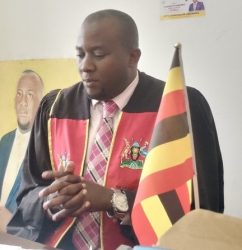
LAND WARS AT ULC! Report Uncovers Billions Spike, Missing Land Records & Grab Scandals as Bosses Face Heat
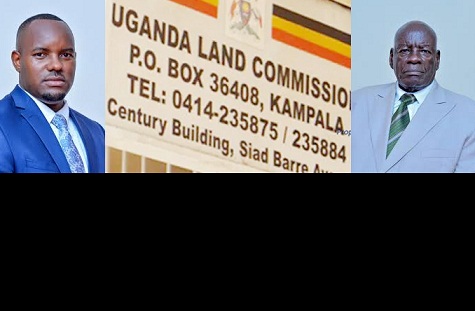
A fresh Auditor General’s report has detonated a political and administrative bombshell at the Uganda Land Commission, exposing a catalogue of failures, ballooning financial obligations and weak land governance that has left prime government property vulnerable to encroachment, subdivision and outright grabbing.
At the centre of the storm is Commission Chairperson Professor Nyeko Pen Mogi, who took over following the dramatic suspension of his predecessor, alongside Secretary Andrew Nyumba and a board sworn in on October 28, 2024, including Bujara Rukiika Augustine, Hajj Asuman Kyaffu, Stella Acan, Tumusiime Bikaako Rosemary and Nduhura Dennis Mwebaze — all now staring down hard questions over how the country’s most sensitive asset, land, is being managed.
The report reveals a staggering surge in payables that has sent alarm bells ringing across government. Outstanding obligations shot up from UGX 171.9 billion to a jaw-dropping UGX 316.6 billion — an increase of UGX 144.7 billion, representing an 84 percent spike.
For an institution tasked with safeguarding public land, the ballooning liabilities paint a picture of an agency struggling to keep its financial house in order.
“This represents an increment of UGX 144,721,072,467,” the report states, a figure that underscores the scale of the problem and raises concerns about sustainability.
But the financial strain is only part of the story.
In what could be one of the most damning findings, the Auditor General reveals that the Commission does not maintain a fully updated inventory register of government land. Critical details such as location, tenure status, custody and utilisation are either incomplete or missing altogether.
The implication is chilling.
“I could not confirm the status of government land,” the report notes, effectively admitting that vast swathes of public land may be unaccounted for.
This glaring gap has opened the door to widespread encroachment and illegal dealings, with private individuals reportedly carving out chunks of government land, subdividing it and even securing land titles.
Among the cited cases is Plot 43 Stretcher Road, a relatively small but telling example, as well as the much larger Ministry of Health land at Walukuba Health Centre IV in Jinja City, covering approximately 3,300 hectares — land that has reportedly been eaten into by encroachers.
“Land managed by the Commission… had been encroached on, subdivided and land titles created on it by private individuals,” the report states, exposing what many are now calling a silent land grab unfolding under the Commission’s watch.
The chaos is further compounded by legal and institutional confusion.
Despite being central to land governance, the Uganda Land Commission is still operating without a comprehensive legal framework, with the ULC Bill of 2017 remaining in limbo for nearly a decade.
This legislative vacuum has left the Commission navigating complex land issues without clear legal backing.
At the same time, overlapping mandates between the Commission and District Land Boards have created jurisdictional conflicts, fueling inefficiency and confusion over who is actually in charge.
“This has resulted in conflicting jurisdictions over land management,” the report highlights, pointing to a system that is not only weak but also divided against itself.
Even where the Commission is owed money, it appears reluctant or unable to act.
Despite reporting outstanding ground rent of UGX 2.08 billion, auditors found no evidence of recovery efforts such as issuing demand notices.
In other words, money is owed, but no one is chasing it.
For critics, this is symptomatic of a deeper problem — an institution that is reactive rather than proactive.
Behind the scenes, the leadership dynamics add another layer of intrigue.
Professor Nyeko Pen Mogi, who came in during a turbulent transition following corruption allegations that ousted his predecessor, has been pushing for stronger government control over land to support development projects.
But his tenure has also been marked by internal power struggles and controversial positions that have divided opinion.
Sources say the current leadership bloc consolidated power during the fallout that led to the previous chairperson’s removal, a move that is now being re-examined in light of the Commission’s performance.
As pressure mounts, questions are being asked about whether the current team has the capacity to handle the enormous responsibility placed on it.
Because land in Uganda is not just an asset — it is a political, economic and social lifeline.
And when systems meant to protect it begin to fail, the consequences can be explosive.
The Auditor General’s findings now leave the Commission at a crossroads.
Can it tighten its systems, recover lost ground and restore public confidence?
Or will the cracks exposed in this report widen into a full-blown land governance crisis?
About Post Author