NKUTU FAMILY WAR! Court Finally Speaks, Hands WILL Executors Power Over Multibillion Estate as Youngest Son Questions Rush

A major court ruling has been delivered in the bitter inheritance war that has engulfed the family of the late Christine Namubiru Nkuutu, widow of former Health and Works Minister Shaban Kirunda Nkutu, with the High Court at Entebbe formally granting probate and effectively handing full legal control of the deceased’s vast estate to the executors named in her Will.
The ruling, issued by Justice Flavia K. Nabakooba on May 11, 2026, now places lawyer Brian Alfred Serunjogi and educationist Mariam Luyombo at the centre of one of Uganda’s most closely watched succession battles. The two executors have been granted authority to administer the estate, collect and manage assets, receive rental income, supervise businesses, secure titles, distribute property to beneficiaries and ultimately implement the wishes contained in the final Will of Christine Namubiru Nkuutu.
The court further directed the executors to prepare and file a complete inventory of the estate within six months and submit a full account of administration within one year. The grant remains valid until May 2028.
The ruling comes after months of mounting tension, accusations, counter-accusations, legal battles, police complaints and family divisions that erupted almost immediately after Christine’s death on December 18, 2025.

To understand the significance of the ruling, one must first understand the family at the centre of the dispute.
Christine Namubiru Nkuutu was the widow of the late Shaban Kirunda Nkutu, one of the most prominent politicians of post-independence Uganda who served as Minister of Health and later Minister of Works before being killed during the Idi Amin regime in 1973.

Following the minister’s death, Christine remained with two children, Conrad Kirunda Nkutu and Sophie Michaela Kitimbo Nkutu.
Conrad would later become one of Uganda’s most recognizable corporate executives, serving as Managing Director of Daily Monitor and later becoming a senior executive at Tullow Oil before taking on various board appointments and consultancy roles.
His sister Sophie Michaela Kitimbo Nkutu also remained actively involved in family affairs and business interests.

Years later, Christine, after Nkutu’s death, rebuilt her life and had two more children with Joseph Musisi Mwanje of Kitala near Entebbe. These children were Martin Jack Kintu Mwanje and Emmanuel Balaba Kavuma.
The result was a blended family consisting of four children from two different unions.
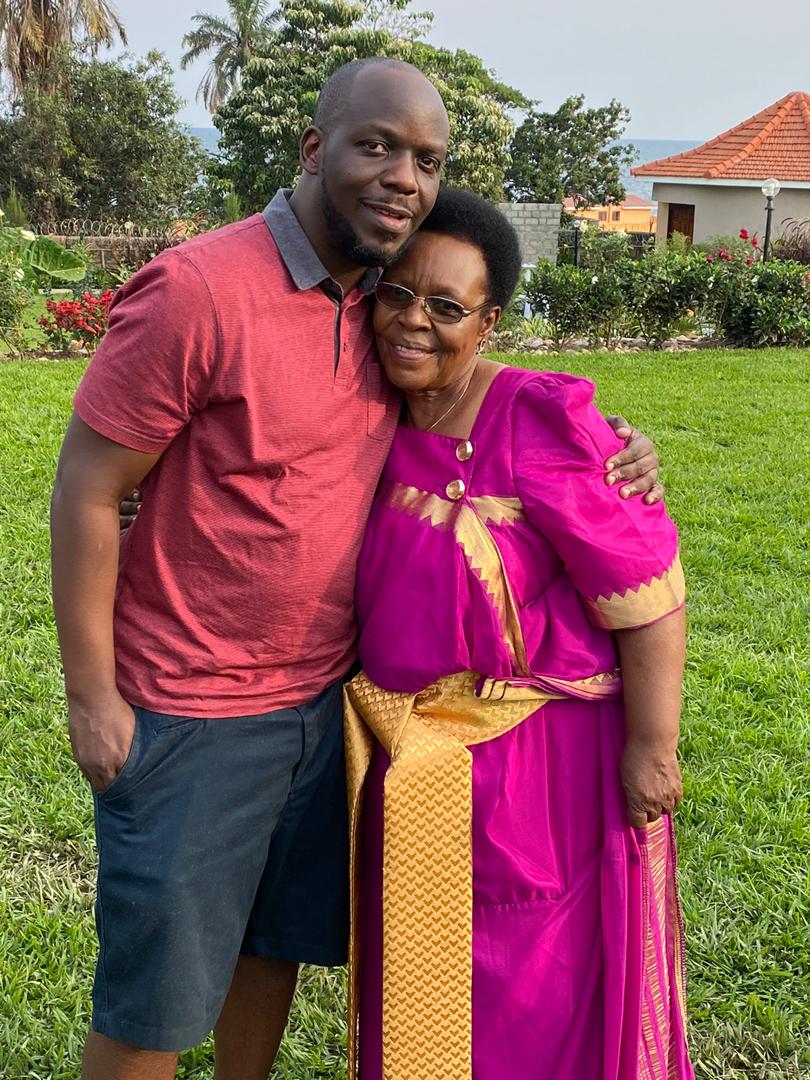

Over the decades, Christine built a substantial property empire reportedly worth millions of dollars. Family sources describe the estate as consisting of hotels, apartments, residential homes, gardens, rental properties, businesses and large tracts of land spread across several locations.
One of the major vehicles through which many of the assets were managed was Sophies Limited, a family company under which businesses such as Sophies Signature Suites and Sophies Lake View Gardens operated.
All four children reportedly served as shareholders and directors within the company structure together with their mother.
However, it was the youngest son, Emmanuel Balaba Kavuma, who appears to have been entrusted with operational control of many of the family businesses in the years leading up to Christine’s death.
According to correspondence exchanged between family members and executors, Kavuma became Managing Director of Sophies Limited in May 2021.
He also says he managed the apartments located at Plot 47 Circular Road in Bugonga, Entebbe and exercised direct control over several family properties, workers, businesses and daily operations.
According to Kavuma, by the time his mother died, he was effectively running the empire on her behalf.
The situation changed dramatically on December 18, 2025 with Christine’s passing.
According to the youngest sibling, events that followed his mother’s death triggered a family conflict that has since exploded into one of the most bitter succession wars in recent memory.
Kavuma alleges that immediately after Christine’s death, his siblings Conrad, Sophie and Martin authorized the breaking into of two key family properties, namely the Kabaganda home in Kiteezi and the Alice Reef properties in Bugonga, Entebbe.


He claims that before the death of his mother, he had been living alone at the Kabaganda home since February 2025 with her consent.
According to him, the property was not merely a residence but his primary home and office.
He says he reared poultry on the premises and maintained several animals there, including dogs.
He claims ownership of two dogs named Bobi and Burna and further argues that another dog named Buster belonged to the late Christine and should eventually pass to him unless another beneficiary establishes a superior claim.
Kavuma further claims that on November 17, 2025, approximately one month before her death, Christine gifted him all furnishings and household contents inside the Kabaganda residence.
According to him, documentary evidence exists to support this claim and has already been shared with various individuals connected to the estate.
But the biggest issue raised by the youngest son concerns access to the properties.
He alleges that after his siblings took over the homes, he was effectively locked out and deprived of access to premises where he had been living and working.
According to his account, he was rendered homeless and lost access to personal documents, valuables, cash, business records, office equipment and other personal belongings allegedly kept inside the homes.
He says the Kabaganda residence was his primary home while a suite located at Sophies Signature Suites in Bugonga served as his second home and office.
Kavuma insists that before the death of his mother he enjoyed full control of several homes, businesses and workers and that this arrangement was abruptly overturned after her death.
The family conflict soon spilled into court.
Earlier this year, Conrad Kirunda Nkutu, Sophie Michaela Kitimbo Nkutu and Martin Jack Kintu Mwanje dragged their younger brother to court, accusing him of harassment, intimidation and threatening conduct through emails, WhatsApp messages and other communications.
The matter was filed before the Chief Magistrate’s Court at Kira.
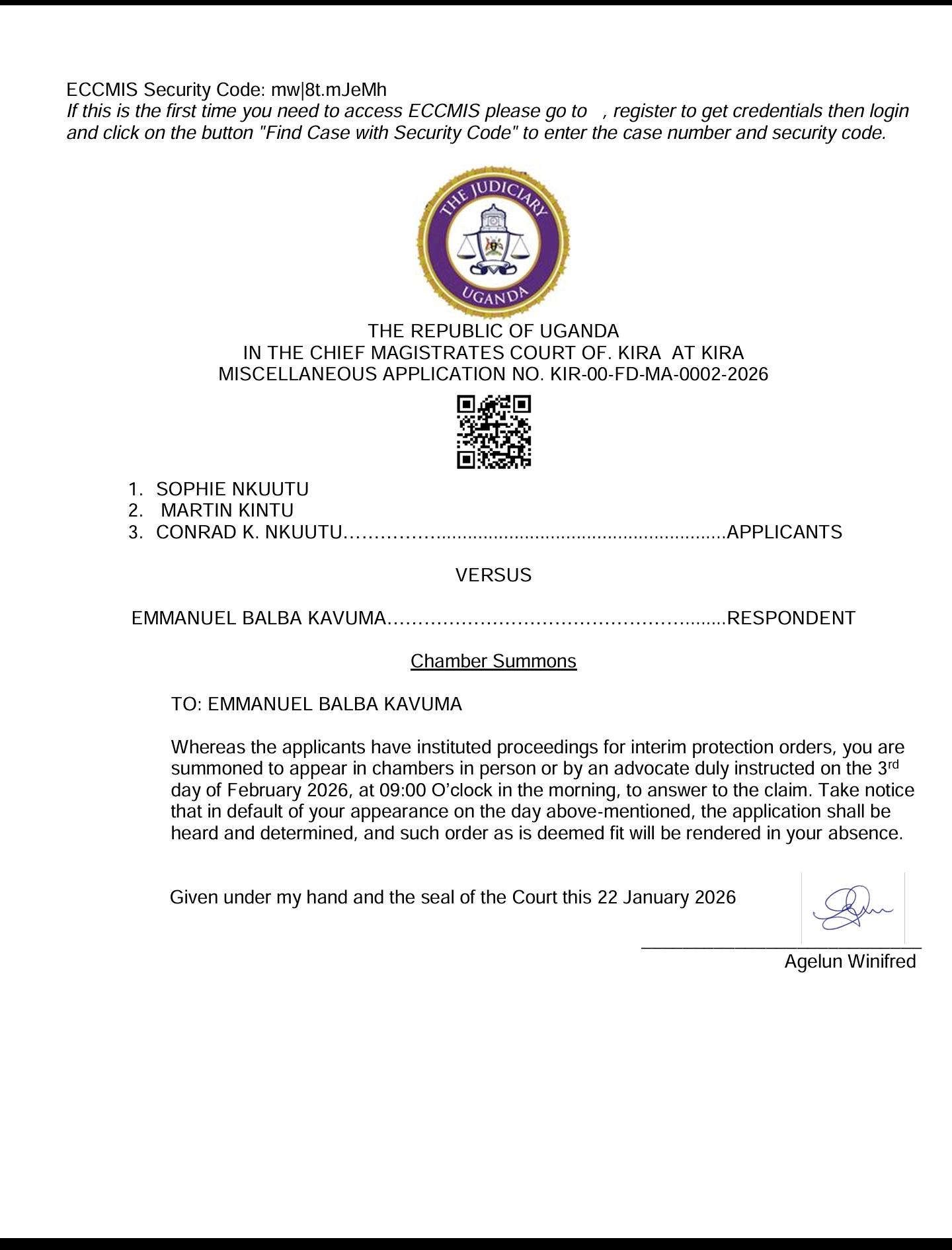
The court eventually granted protection orders after finding that material presented before it amounted to emotional and psychological abuse under the Domestic Violence Act.
However, the magistrate deliberately avoided making determinations regarding ownership and control of estate property, directing instead that those matters be resolved through the probate process before the High Court.
That directive has now resulted in the probate ruling delivered at Entebbe.
At the centre of the conflict lies the Will itself.
The Will was formally read on January 21, 2026 and immediately became a source of controversy.
Family sources say the document contains detailed instructions regarding the distribution of virtually every major asset accumulated by Christine over her lifetime.
The Will reportedly distributes homes, apartments, businesses and land among children and grandchildren.
The distribution has generated considerable debate because some beneficiaries inherited complete properties while others received shared interests.
According to sources familiar with the contents of the document, the luxurious residence located on Plot 3 Alice Reef Close in Bugonga, Entebbe was bequeathed to Emmanuel Balaba Kavuma.
This property has become one of the most contested assets because Kavuma claims he has been denied access to it despite being its intended beneficiary under the Will.
Another major property is the Kabaganda residence in Kiteezi.
This home carries immense sentimental value because it became Christine’s final resting place.
Under the Will, the property was reportedly left jointly to Sophie Michaela Kitimbo Nkutu, Martin Jack Kintu Mwanje and Emmanuel Balaba Kavuma.
Conrad Kirunda Nkutu was reportedly not included among the beneficiaries of this specific property.
Perhaps the most significant provision concerning the Kabaganda home is a clause reportedly inserted by Christine herself prohibiting its sale.
According to court documents, the Will expressly states that the property should never be sold.
The clause reportedly goes further by providing that none of Christine’s children should ever be denied access to the home and that any child facing accommodation challenges should be free to stay there.

That provision now forms a major pillar of Kavuma’s argument.
He questions how he can be denied access to a home whose governing Will allegedly guarantees access to every child of the deceased.
The executors have now entered the picture armed with the authority granted by the High Court.
Immediately after obtaining probate, they wrote to all four children informing them that the estate was now under their control.
They demanded that all estate documents, assets, rental income streams and properties be surrendered.
They directed that no beneficiary should continue collecting rent from estate properties after June 1, 2026.
They further requested accountability regarding income collected from estate properties between Christine’s death and the commencement of probate administration.
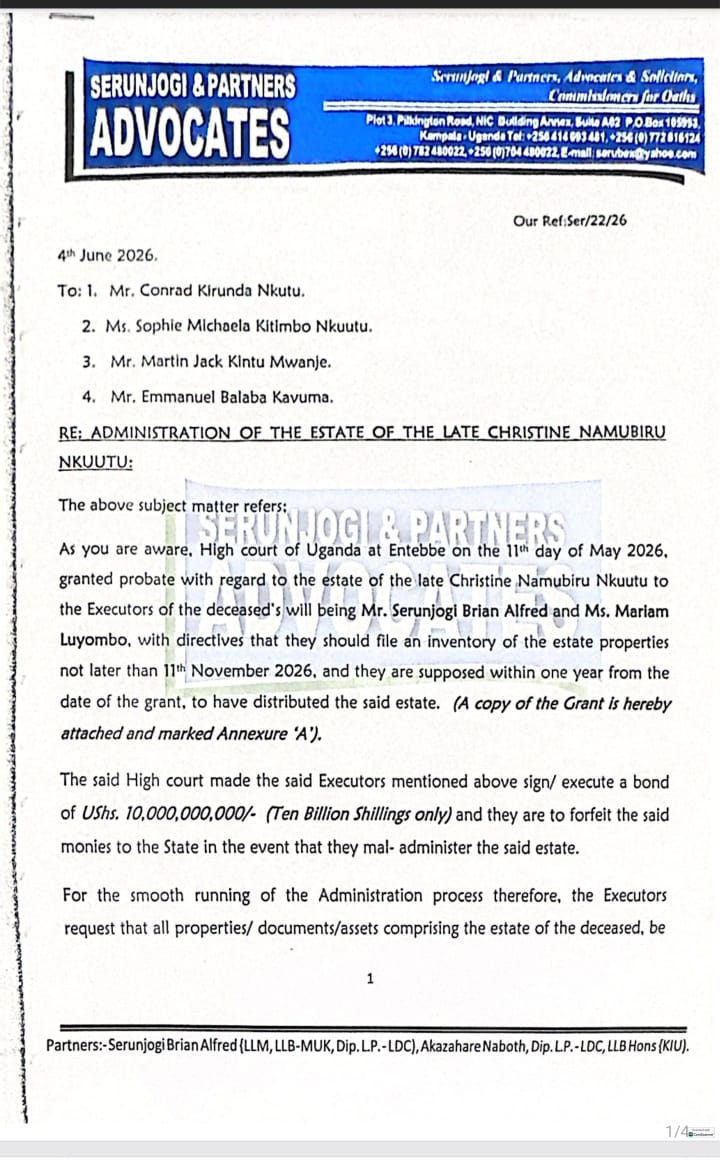
The executors then announced a timetable for physically taking possession of the estate.
The apartments at Plot 47 Circular Road in Entebbe were among the first properties scheduled for takeover.
The Alice Reef properties in Bugonga followed shortly thereafter.
The Kabaganda residence was also placed on the handover schedule.
The executors additionally announced plans to engage surveyors to separate the residential home at Alice Reef from the hospitality business operating on adjacent property so that separate land titles could eventually be issued to beneficiaries.
The letters immediately triggered resistance from Kavuma.
The youngest sibling questioned why the executors appeared to be moving with such speed.
He wondered why handovers were being scheduled before questions regarding access to his homes and offices had been resolved.
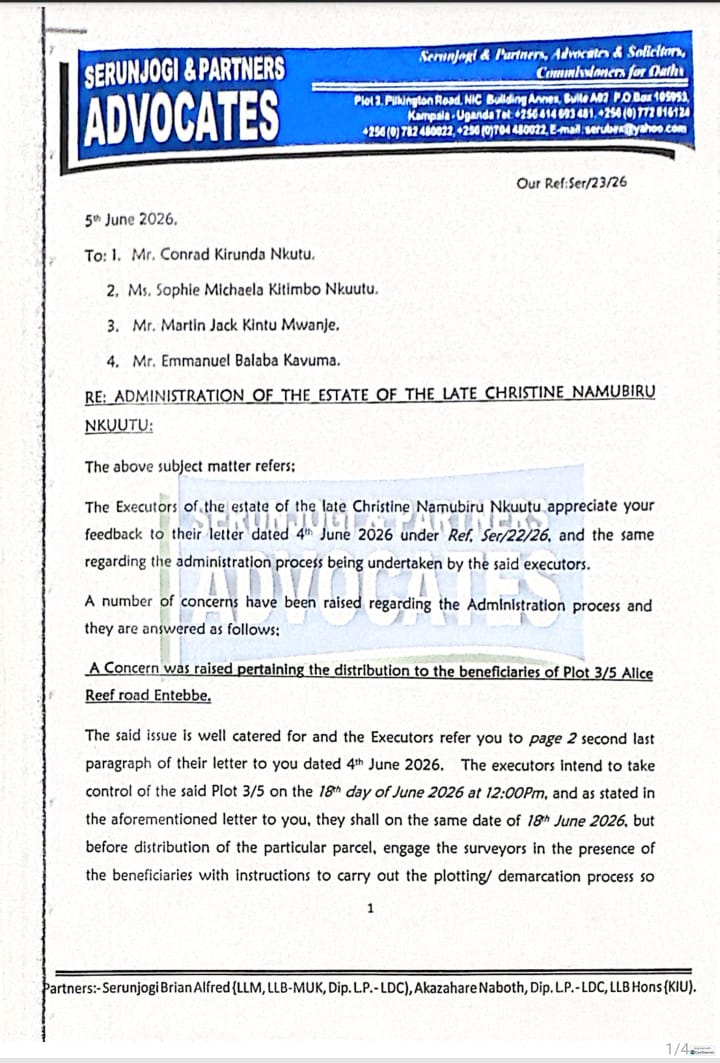
He asked why he was expected to surrender properties and management responsibilities while still allegedly being denied access to his personal belongings.
He questioned whether probate powers could operate retrospectively and whether executors could demand accountability for periods before probate had even been granted.
He further questioned whether the estate administration process should not begin with properties allegedly under the control of his siblings.

Another issue raised by Kavuma concerns his role as property manager.
He argues that his responsibilities went far beyond collecting rent.
According to him, he managed tenancy agreements, inventories, maintenance, staff, utility payments, taxes and general operations.
He therefore questioned whether the executors could simply assume control without formally terminating management arrangements and clarifying any obligations arising from them.
He also questioned why executors appeared eager to take possession of properties before determining ownership of personal belongings, cash and records allegedly stored inside.
The executors responded firmly.
In a strongly worded letter, they informed Kavuma that the law grants executors all rights that belonged to the deceased.
They cited provisions of the Succession Act which state that probate effectively vests estate powers in executors as though those powers arose immediately after death.
They rejected suggestions that the handover process could be subjected to conditions.
They informed him that estate assets had to be surrendered for administration.
Most significantly, the executors warned against what they termed intermeddling with the estate.
They specifically referred to provisions of the Succession Act providing criminal sanctions against individuals who interfere with estate property without authority.
The letter warned that such conduct could attract criminal liability and imprisonment.
The warning dramatically escalated the dispute because it introduced the possibility of criminal complaints arising from actions taken by beneficiaries during the administration process.
At the same time, the executors attempted to answer concerns raised by the children.
They indicated that questions regarding gifts allegedly made by Christine before her death would be examined once documentary evidence was produced.
They also indicated that beneficiaries claiming personal belongings inside estate properties would be given an opportunity to identify and recover them during inventory exercises.

On the issue of Kabaganda, the executors acknowledged concerns raised regarding future management of the property but emphasized that the Will expressly prohibits its sale.
They also noted proposals suggesting the creation of a trust arrangement but stopped short of endorsing any specific solution.
The executors further acknowledged that some beneficiaries may have used personal funds to keep estate operations running after Christine’s death and indicated that legitimate claims could potentially be reimbursed once verified.
Meanwhile, tenants occupying estate properties have already been notified that management has changed.
The executors instructed them to stop remitting rent through previous arrangements and instead channel payments through the estate administration structure established after probate.
For now, the ruling means one thing above all else: the battle has entered a completely new phase.
The question of who controls the estate has effectively been answered by the High Court.
The executors are now in charge.
The next battle will concern implementation of the Will itself, verification of claims by beneficiaries, recovery of assets, determination of ownership rights, resolution of occupancy disputes and eventual distribution of a family empire built over decades.
With four children, multiple properties, competing claims, allegations of exclusion, accusations of forceful takeovers, questions about gifted assets, disputes over homes, rental income, business interests and a fortune reportedly running into millions of dollars, the Nkuutu succession war appears far from over.
Red Pepper will keep you updated despite protests from Conrad Nkuutu.
Watch this Space!
GOT A HOT STORY? EMAIL: redpeppertips@gmail.
SOURCE PROTECTION/CONFIDENTIALITY IS OUR NO.1 PRIORITY.
About Post Author