DEAD ON ARRIVAL? Farmers Curse MAAIF, Protest Shs54,000 Charge as ‘Free’ Fertilizer Distribution Sparks Allocation, Quality Questions

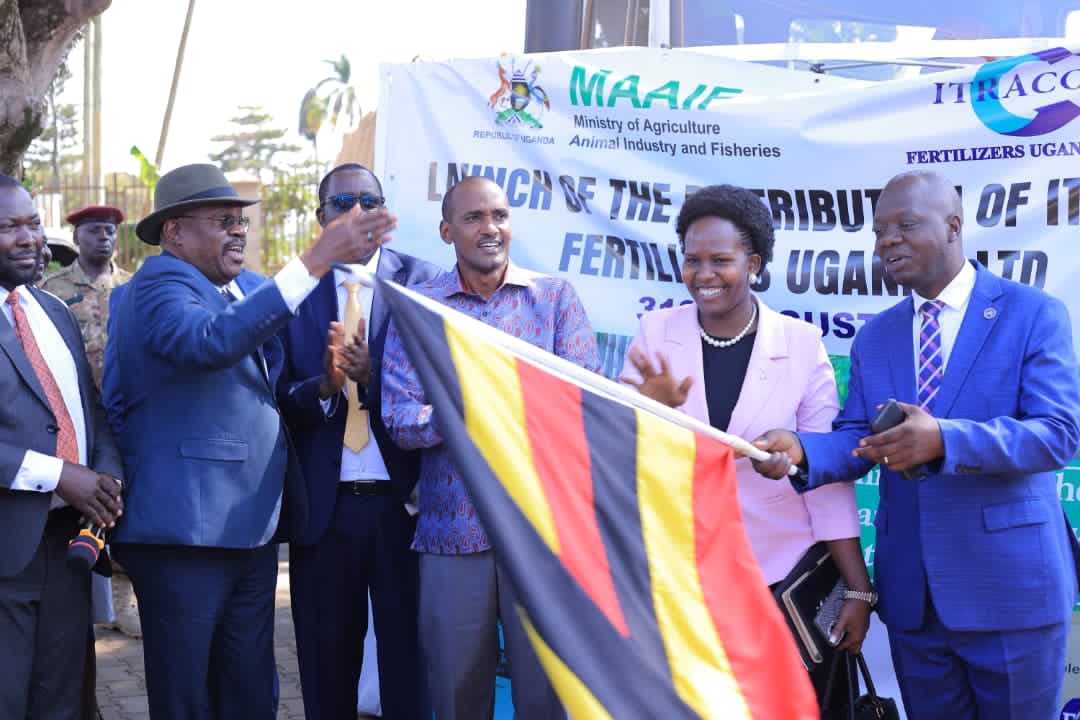
The free fertiliser distribution programme was officially launched on Monday, August 31, 2026, at the Ministry of Agriculture, Animal Industry and Fisheries (MAAIF) headquarters in Entebbe.
KAMPALA — A Government fertilizer programme designed to revive Uganda’s soils, boost coffee, tea, cocoa and horticulture production and lift farmers’ incomes has run into a storm, with farmers questioning why they are being asked to part with money for an intervention repeatedly presented as Government support.
The programme, being implemented by the Ministry of Agriculture, Animal Industry and Fisheries (MAAIF), involves the distribution of tens of thousands of 50kg bags of fertilizer to farmers across selected districts, with two firms — DEI Biopharma Ltd and Itracom Fertilizers Ltd — contracted to supply the inputs.
But farmers are now raising questions over money being demanded from beneficiaries, the basis of district allocations, the quantity given to individual farmers, the distribution mechanism and the quality and background of the suppliers.
The biggest controversy centres on the question of whether the fertilizer is actually free.
A July 16, 2026 MAAIF PS Maj. Gen. (Rtd) David Kasura-Kyomukama communication to Chief Administrative Officers (CAOs), Resident District Commissioners (RDCs) and District Production Officers in beneficiary districts says the Government fertilizer intervention is being implemented under the Government Fertilizer Subsidy Programme, under which Government has subsidised 70 percent of the cost while beneficiary farmers are required to contribute the remaining 30 percent — stated in the letter as Shs54,000 for every 50kg bag.
The same communication says the detailed modalities for collecting the farmer contribution, including collection procedures, banking arrangements and reporting requirements, were to be communicated separately.
This is where farmers say the programme becomes confusing.
The MAAIF Fertilizer Distribution Strategy, however, contains a different instruction on the ground.
The strategy says beneficiaries should be individually notified of the “zero-cost nature” of the distribution and that no person should demand payment from them.
It further says the Permanent Secretary’s communication to districts should prohibit charging farmers fees, while the safeguards section expressly prohibits resale, diversion, hoarding or charging any fee in relation to the initial phase of the fertilizer programme.
The strategy even warns that such conduct constitutes a criminal offence and a breach of public trust. It also provides for public observation of distribution exercises and internal MAAIF spot audits comparing beneficiary lists, Goods Received Notes and distribution sheets.
That apparent contradiction — a 30 percent farmer contribution in one MAAIF communication against a zero-cost/no-payment instruction in the distribution strategy — has left farmers questioning exactly what they are expected to pay, if anything.
FARMERS: WHY PAY FOR ‘FREE’ FERTILIZER?
Farmers who spoke to Red Pepper say they were attracted to the programme because they understood that Government had procured the fertilizer as an intervention to improve productivity and restore soil fertility.
Instead, some say they have been confronted with demands for money.
For a farmer receiving one 50kg bag, the figure cited in the July 16 MAAIF letter is Shs54,000.
For farmers already struggling with high costs of labour, seedlings, pesticides, transport and other farm inputs, the demand has triggered anger.
The complaints have become even sharper because the distribution strategy itself says beneficiaries should be informed that the fertilizer is being distributed at zero cost and that nobody should demand payment.
The official strategy says the programme is intended to ensure that fertilizer reaches the intended farmers without diversion, loss or unnecessary delay, while also reducing costs to farmers, particularly transport costs.
It requires districts to notify farmers in advance of the distribution date, collection point and quantity they are entitled to receive.
It also requires beneficiaries to present identification, sign for the quantities received and have their details captured in standardised distribution sheets.
‘ONE BAG FOR A 10-ACRE FARM?’
Beyond the payment controversy, farmers are questioning the allocation formula at individual household level.
One of the major complaints is that farmers with vastly different farm sizes can receive the same allocation.
Farmers say a person cultivating one or two acres of coffee, tea or cocoa can end up receiving the same 50kg bag as another farmer managing more than 10 acres.
This, they argue, defeats the purpose of using fertilizer to improve productivity because the quantity required by a farmer should logically be linked to the size of the crop enterprise.
One coffee farmer told Red Pepper that he rejected the one-bag allocation because he considered it inadequate for his farm.
“If the system of distribution can’t be harmonized, then the project is dead on arrival,” the farmer said.
The MAAIF distribution strategy itself requires beneficiary lists to include the farmer’s estimated acreage under the relevant crop, the number of bags allocated, the farmer’s location, crop enterprise and identification details.
The strategy also gives MAAIF power to review submitted lists and make adjustments depending on resource availability, production records, previous Government support received by a farmer and quantities considered necessary.
This has prompted farmers to ask why acreage information is collected if the eventual allocation does not adequately distinguish between small and large farms.
Farmers are asking: If acreage is part of the official beneficiary data, why should a farmer with one or two acres receive the same quantity as one cultivating more than 10 acres?
That is the question now hanging over the programme.
DISTRICTS DISTRIBUTION RATIONALE
Farmers are also questioning the district-level allocation formula.
They argue that some districts with relatively smaller areas under particular strategic crops appear to receive substantial quantities, while areas where farmers say there are larger concentrations of coffee, tea or cocoa can receive comparatively different allocations.
Bukomansimbi and Kole have been cited by farmers as one of the examples in the debate, although the official schedule covers different crop categories and the allocations cannot simply be compared without considering the specific crop, production records and criteria used by MAAIF.
The ministry says allocations are guided by existing crop production data, acreage under each crop and the Presidential Directive prioritising Parish Development Model beneficiaries.
The strategy says district allocations are based on crop production records held by MAAIF departments, registered PDM household coverage in crop-producing parishes, acreage under each crop and the need for equitable distribution in line with the Presidential Directive.
The district schedules, however, provide a revealing picture of how widely the fertilizer is being spread.

FARMERS QUESTION QUALITY
Alongside the money and allocation complaints, some farmers are raising questions about the fertilizer itself.
Several farmers told Red Pepper they are hesitant about the quality of the products and say they want greater clarity on what exactly they are receiving, how the products were selected and what quality assurance was carried out before distribution.
One farmer questioned the involvement of the two suppliers, particularly DEI Biopharma, arguing that the company is not widely known among farmers primarily as a fertilizer manufacturer.
“We have been hearing about Magoola’s Bio Pharma in medicine, bakery flour… Now all of a sudden in fertilizer. Really?” the farmer asked.
The farmer also expressed reservations about Itracom, saying some farmers were unfamiliar with the company and its operations in Uganda.
“Then the other firm, Itracom, it has just started operations in Uganda. We don’t know much about it,” the farmer said.
The farmer added: “Free things are always expensive, I rest my case.”
The comments reflect farmers’ perceptions and reservations, rather than an established finding that either supplier’s fertilizer is substandard.
THE COFFEE AND COCOA ALLOCATION
According to the MAAIF schedule, the coffee and cocoa allocation covers 78,462 bags of 50kg NPK for coffee and 34,773 bags of 50kg NPK for cocoa.
The Northern region receives cocoa fertilizer only under this schedule, with Agago getting 200 bags, Alebtong 114, Amuru 200, Dokolo 200, Gulu 200, Kitgum 200, Lamwo 200, Lira 200, Nwoya 200, Omoro 200, Oyam 200 and Pader 200 — all listed under DEI Biopharma. The Northern total is 2,314 cocoa bags.
In the South Western region, the schedule assigns Itracom:
- Buhweju: 800 coffee, 200 cocoa
- Bushenyi: 1,000 coffee
- Isingiro: 1,000 coffee, 200 cocoa
- Kazo: 800 coffee, 200 cocoa
- Kiruhura: 800 coffee, 200 cocoa
- Mbarara: 1,000 coffee, 200 cocoa
- Mitooma: 1,000 coffee
- Ntungamo: 1,800 coffee, 400 cocoa
- Rubirizi: 800 coffee, 200 cocoa
- Rukungiri: 1,200 coffee
- Rwampara: 800 coffee, 200 cocoa
- Sheema: 1,000 coffee, 200 cocoa
- Ibanda: 200 coffee, 300 cocoa
The South Western total is 12,200 coffee bags and 2,300 cocoa bags, all assigned to Itracom.

CENTRAL REGION
The Central schedule shows a much wider mixture of allocations.
DEI Biopharma is listed for:
- Buikwe: 800 coffee, 400 cocoa
- Bukomansimbi: 2,000 coffee, 400 cocoa
- Butambala: 800 coffee, 400 cocoa
- Buvuma: 1,000 coffee, 400 cocoa
- Gomba: 800 coffee
- Jinja City: 1,000 coffee, 400 cocoa
- Kalangala: 800 coffee, 400 cocoa
- Kalungu: 800 coffee, 200 cocoa
- Kassanda: 600 coffee, 200 cocoa
- Kayunga: 600 coffee, 400 cocoa
- Kyankwanzi: 600 coffee
- Kyotera: 600 coffee, 200 cocoa
- Luwero: 600 coffee, 400 cocoa
- Lwengo: 600 coffee
- Lyantonde: 600 coffee
- Masaka: 600 coffee
- Mityana: 600 coffee
- Mpigi: 600 coffee, 500 cocoa
- Mubende: 600 coffee, 700 cocoa
- Mukono: 600 coffee, 1,200 cocoa
- Nakaseke: 600 coffee, 591 cocoa
- Nakasongola: 600 coffee, 300 cocoa
- Rakai: 600 coffee
- Sembabule: 600 coffee
- Wakiso: 600 coffee, 800 cocoa.
The Central total shown in the schedule is 19,869 coffee bags and 8,091 cocoa bags.
The schedule separately lists Kampala with 669 coffee bags and no cocoa, and Kiboga with 1,000 coffee and 200 cocoa, both under Itracom.
EASTERN REGION
The Eastern allocation, all listed under Itracom, is:
- Budaka: 800 coffee, 300 cocoa
- Bugiri: 800 coffee, 700 cocoa
- Bugweri: 800 coffee, 300 cocoa
- Butaleja: 800 coffee, 300 cocoa
- Butebo: 800 coffee, 300 cocoa
- Buyende: 800 coffee, 500 cocoa
- Iganga: 1,000 coffee, 500 cocoa
- Jinja: 1,000 coffee, 400 cocoa
- Kaliro: 600 coffee, 500 cocoa
- Kamuli: 1,000 coffee, 1,000 cocoa
- Kibuku: 600 coffee, 400 cocoa
- Luuka: 600 coffee, 500 cocoa
- Mayuge: 1,000 coffee, 1,686.5 cocoa
- Namayingo: 600 coffee, 400 cocoa
- Pallisa: 200 coffee, 200 cocoa
- Tororo: no coffee, 500 cocoa
- Namutumba: 200 coffee, 100 cocoa.
The Eastern total is 11,600 coffee bags and 8,586.5 cocoa bags.
WESTERN REGION
The Western schedule, also under Itracom, gives:
- Buliisa: 400 coffee
- Hoima: 400 coffee, 700 cocoa
- Kikuube: 400 coffee, 800 cocoa
- Kagadi: 800 coffee, 700 cocoa
- Kakumiro: 1,000 coffee, 800 cocoa
- Kibaale: 800 coffee, 800 cocoa
- Masindi: 800 coffee, 500 cocoa
- Kiryandongo: 800 coffee, 400 cocoa
- Busia: 400 coffee, 200 cocoa.
The regional total is 5,800 coffee bags and 4,900 cocoa bags.
ELGON REGION
Under DEI Biopharma, the Elgon allocation is:
- Bududa: 331 coffee
- Bukwo: 400 coffee
- Bulambuli: 800 coffee, 200 cocoa
- Kapchorwa: 400 coffee
- Kapelebyong: 500 cocoa
- Kween: no coffee or cocoa quantity shown
- Manafwa: 800 coffee, 400 cocoa
- Mbale: 1,000 coffee, 500 cocoa
- Namisindwa: 800 coffee, 100 cocoa
- Sironko: 800 coffee, 400 cocoa.
The regional total is 5,331 coffee bags and 2,100 cocoa bags.
TESO
The Teso schedule contains:
- Bukedea: 500 coffee — Itracom
- Katakwi: 400 coffee — Itracom
- Serere: 200 cocoa — DEI Biopharma
- Soroti: 200 cocoa — DEI Biopharma.
The Teso total is 900 coffee and 400 cocoa bags.
KIGEZI
DEI Biopharma is assigned:
- Kabale: 400 coffee, 400 cocoa
- Kanungu: 800 coffee, 800 cocoa
- Kisoro: 800 coffee, 800 cocoa
- Rubanda: 800 coffee, 800 cocoa
- Rukiga: 400 coffee, 400 cocoa.
Total: 3,200 coffee and 3,200 cocoa bags.
RWENZORI
DEI Biopharma is assigned:
- Bundibugyo: 400 coffee, 1,582 cocoa
- Bunyangabu: 400 coffee, 400 cocoa
- Fort Portal City: 200 coffee, 100 cocoa
- Kabarole: 800 coffee, 200 cocoa
- Kamwenge: 1,000 coffee, 400 cocoa
- Kasese: 2,000 coffee, 700 cocoa
- Kibaale: 400 coffee, 500 cocoa
- Kyegegwa: 600 coffee
- Kyenjojo: 400 coffee, 400 cocoa
- Ntoroko: 400 coffee, 400 cocoa
- Kitagwenda: 600 coffee, 200 cocoa.
The sub-total is 7,200 coffee and 4,882 cocoa bags.
WEST NILE AND CITIES
Itracom allocations are:
- Adjumani: 400 coffee
- Arua: 400 coffee, 200 cocoa
- Arua City: 400 coffee
- Koboko: 200 coffee, 600 cocoa
- Madi-Okollo: 200 coffee
- Maracha: 200 coffee, 100 cocoa
- Moyo: 200 coffee, 200 cocoa
- Nebbi: 400 coffee
- Obongi: 200 coffee
- Pakwach: 200 coffee
- Terego: 200 coffee
- Yumbe: 400 coffee, 100 cocoa
- Zombo: 800 coffee, 200 cocoa
- Gulu City: 600 coffee
- Mbale City: 200 coffee
- Mbarara City: 800 coffee
- Masaka City: 462 coffee
- Hoima City: 200 coffee, 200 cocoa.
The combined total is 6,462 coffee bags and 1,600 cocoa bags. The annex gives an overall coffee figure of 78,462 bags and cocoa figure of 34,773 bags.
TEA MONEY TRAIL
The programme does not stop at coffee and cocoa.
The MAAIF provides a separate 117,391-bag allocation of 50kg tea fertilizer, all assigned to Itracom.
The largest tea allocations include:
- Bushenyi — 18,000 bags
- Buhweju — 18,000
- Kyenjojo — 17,050
- Kabarole — 15,000
- Kanungu — 10,000
- Mitooma — 9,000
- Sheema — 9,000
- Kamwenge — 4,000
- Kisoro — 2,500
- Ntungamo — 2,000
- Rubirizi — 2,000
- Rukungiri — 200
- Rukiga — 200
- Rubanda — 200
- Kibale — 200
- Mubende — 200
- Mukono — 105
- Wakiso — 100
- Masaka — 100
- Zombo — 136
- Buikwe — 800
- Mityana — 1,000
- Kagadi — 2,000
- Kikuube — 800
- Hoima — 500
- Fort Portal — 500
- Kabale — 1,800.
HORTICULTURE: ANOTHER 117,391 BAGS
The third arm of the programme is horticulture, with 117,391 bags of 50kg NPK allocated to districts for priority distribution to PDM beneficiaries.
Unlike the coffee, cocoa and tea schedule, the horticulture allocation is overwhelmingly uniform — with most districts receiving either 900 bags or 700 bags, while the listed cities receive 158 bags and Jinja City receives 400.
All the horticulture fertilizer in this schedule is assigned to DEI Biopharma.
NORTHERN HORTICULTURE ALLOCATION
Each of the following receives 900 bags from DEI Biopharma:
Agago, Alebtong, Amolatar, Amuru, Apac, Dokolo, Gulu, Kitgum, Kole, Kwania, Lamwo, Lira, Nwoya, Omoro, Otuke, Oyam and Pader.
SOUTH WESTERN
Each receives 900 bags from DEI Biopharma:
Buhweju, Bushenyi, Ibanda, Isingiro, Kazo, Kiruhura, Mbarara, Mitooma, Ntungamo, Rubirizi, Rukungiri, Rwampara and Sheema.
CENTRAL
The schedule gives 900 bags each to:
Buikwe, Bukomansimbi, Butambala, Buvuma, Gomba, Kalangala, Kalungu, Kampala, Kassanda, Kayunga, Kiboga, Kyankwanzi, Kyotera, Luwero, Lwengo, Lyantonde, Masaka, Mityana, Mpigi, Mubende, Mukono, Nakaseke, Nakasongola, Rakai, Sembabule and Wakiso.
Jinja City gets 400 bags.
All are listed under DEI Biopharma.
EASTERN
The following districts each receive 900 bags from DEI Biopharma:
Budaka, Bugiri, Bugweri, Butaleja, Butebo, Buyende, Iganga, Jinja, Kaliro, Kamuli, Kibuku, Luuka, Mayuge, Namayingo, Pallisa, Tororo and Namutumba.
WESTERN
Each of these receives 900 bags from DEI Biopharma:
Buliisa, Hoima, Kikuube, Kagadi, Kakumiro, Kibaale, Masindi, Kiryandongo and Busia.
ELGON
Each of the following receives 900 bags from DEI Biopharma:
Bududa, Bukwo, Bulambuli, Kapchorwa, Kapelebyong, Kween, Manafwa, Mbale, Namisindwa and Sironko.
TESO/KARAMOJA
The schedule gives 700 bags each to:
Abim, Amudat, Amuria, Bukedea, Kaabong, Kaberamaido, Kalaki, Karenga, Katakwi, Kotido, Kumi, Moroto, Nabilatuk, Nakapiripirit, Napak, Ngora, Serere and Soroti.
All are assigned to DEI Biopharma.
KIGEZI
Each receives 700 bags from DEI Biopharma:
Kabale, Kanungu, Kisoro, Rubanda and Rukiga.
RWENZORI
Each receives 700 bags from DEI Biopharma:
Bundibugyo, Bunyangabu, Fort Portal City, Kabarole, Kamwenge, Kasese, Kibaale, Kyegegwa, Kyenjojo, Ntoroko and Kitagwenda.
WEST NILE
Each receives 700 bags from DEI Biopharma:
Adjumani, Arua, Arua City, Koboko, Madi-Okollo, Maracha, Moyo, Nebbi, Obongi, Pakwach, Terego, Yumbe and Zombo.
CITIES
The schedule gives:
- Gulu City — 158 bags
- Mbale City — 158
- Mbarara City — 158
- Masaka City — 158
- Hoima City — 158
All five are assigned to DEI Biopharma. The horticulture schedule gives a grand total of 117,391 bags.
DEI, ITRACOM UNDER FARMERS’ SPOTLIGHT
The scale of the programme means the two contracted suppliers are now firmly in the spotlight.
MAAIF’s strategy identifies Itracom Fertilizers Ltd and Dei Biopharma Ltd as the two suppliers procured under the Presidential Directive for the intervention.
The strategy allocates Itracom fertilizer to tea, as well as substantial coffee and cocoa quantities, while DEI Biopharma is assigned major coffee, cocoa and horticulture quantities.
The July MAAIF letter says DEI Biopharma had indicated that an initial 40,000 bags of 50kg fertilizer were ready for delivery, with the first consignments scheduled for delivery to district stores or designated storage facilities from July 20, 2026.
The distribution strategy says fertilizer should be delivered as close to farmers as possible, preferably to sub-county or parish-level points where roads allow.
It also says suppliers should deliver directly to designated sub-county points where road infrastructure permits.
Where this is impossible, the strategy says delivery should be made to the nearest accessible point and the district should arrange last-mile logistics at no cost to the farmer.
The stated objective is to reduce the distance farmers must travel and cut the transport burden associated with collecting the fertilizer.
GOVT WARNS AGAINST DIVERSION AND SELLING
The fertilizer bags are supposed to carry “Government of Uganda — Not for Sale” markings where operationally feasible.
The strategy prohibits resale, diversion and hoarding and says charging fees in relation to the initial phase is prohibited.
It also calls for distribution exercises to be open to community members, political leaders and the media.
Any surplus is supposed to be immediately reported to MAAIF, together with an account of the remaining bags and a proposed redistribution plan.
MAAIF’s internal audit function is also expected to conduct spot checks by comparing the Goods Received Notes, beneficiary lists and distribution sheets.
Anyone found to have diverted, sold or misappropriated Government fertilizer is to be reported to law enforcement.
THE BIG GOVERNMENT EXPERIMENT
At the centre of the programme is a much bigger agricultural problem.
MAAIF’s strategy says Uganda has one of the lowest fertilizer application rates in Sub-Saharan Africa, putting annual nutrient application at roughly 2–3kg per hectare, compared with a continental average of about 22kg and the Abuja Declaration target of 50kg.
The ministry says continuous cultivation without adequate replenishment of soil nutrients has contributed to widespread nutrient depletion and declining productivity.
The problem, according to the strategy, is especially important for high-value export crops such as coffee, tea and cocoa, where fertilizer use is considered important for competitive yields and quality.
The intervention is therefore intended not simply as a fertilizer giveaway, but as part of a broader effort to restore soil fertility, improve production, increase household incomes and strengthen export earnings.
It is also tied to the Parish Development Model, with priority given to PDM beneficiaries, particularly in the horticulture component.
DISTRICTS FACE STRICT DEADLINES
The programme puts substantial responsibility on district officials.
CAOs are supposed to submit verified beneficiary lists within five days of receiving the allocation communication.
Failure to submit the lists on time can result in the quantities being reallocated to other ready beneficiaries.
Districts must also identify secure storage or delivery points, provide security, communicate with farmers, supervise distribution and submit completion reports.
District Production Officers are responsible for technical verification, receiving consignments, co-signing Goods Received Notes, supervising distribution and training farmers on fertilizer use.
PDM Parish Coordinators and Parish Chiefs are required to verify beneficiaries at the point of distribution and co-sign the distribution register.
FERTILIZER MUST MOVE FAST
MAAIF says fertilizer should not sit in stores for long periods.
Distribution is supposed to begin the same day or the day after delivery.
The reason given is to eliminate storage costs, reduce the risk of diversion and ensure farmers receive the inputs in time for planting.
The strategy further says farmers should be notified before delivery so that they are ready to collect the fertilizer when the consignment arrives.
Where possible, suppliers are expected to deliver directly to sub-county points.
The Government strategy says this is intended to reduce farmer travel distances, transport costs, congestion and the risks associated with centralised collection points.
AUDIT TRAIL CREATED
The programme has also created an extensive paper trail.
For every consignment, officials are expected to record when and where it was delivered, the supplier, contract reference, number of bags, crop type, batch identification and the condition of the fertilizer.
The receiving official and supplier representative must sign the Goods Received Note.
The distribution reports are expected within five days of each distribution event.
The strategy also requires internal spot audits and a weekly overall distribution progress report.
The ministry intends to track the impact of the fertilizer beyond distribution.
Agricultural extension officers are supposed to visit sampled beneficiaries within one crop season to determine whether the fertilizer was actually applied to the intended crop and whether there were observable changes in yields and productivity.
THE FARMERS’ DEMAND
For the farmers, however, the immediate issue is simpler: What exactly is free, what exactly must they pay, and why?
They also want MAAIF to explain why allocations are being made in the quantities shown in the district schedule and whether the acreage of individual farmers is being adequately considered.
They want clarity on how beneficiaries were selected, how the crop data was generated and how farmers cultivating substantially larger areas are expected to benefit from a single 50kg bag.
They also want greater transparency over the suppliers, the quality assurance process and the basis on which the Government decided which company should supply which crop and district.
Most importantly, farmers want the contradictory messages resolved.
One official MAAIF document says a farmer contributes Shs54,000 for a 50kg bag under a 70-percent Government subsidy.
Another section of the ministry’s own distribution framework says beneficiaries should be told the fertilizer is zero-cost and that no one should demand payment.
Until that contradiction is resolved, the much-publicised fertilizer intervention risks being overshadowed by the very questions it was supposed to eliminate — who gets the fertilizer, how much they get, who pays, who supplies it and whether the system is genuinely helping the farmer at the last mile.
Red Pepper has contacted the relevant MAAIF officials and the suppliers for clarification on the farmer contribution, allocation formula, quality assurance and distribution arrangements.
Their responses will be published when received.
GOT A HOT STORY? LET US KNOW!
Got breaking news, explosive secrets, or hard evidence?
Email us: redpeppertips@gmail.com
We accept tips, documents, videos, photos, and recordings—the more evidence you have, the better.
CONFIDENTIALITY IS OUR TOP PRIORITY. SOURCES ARE ALWAYS PROTECTED!
About Post Author