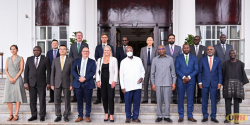
TRAPPED IN MYANMAR HELL! HRA Boss Demands Myanmar Govt Dismantle Scam Compounds & Free Ugandans Trapped in Forced Labour Operations
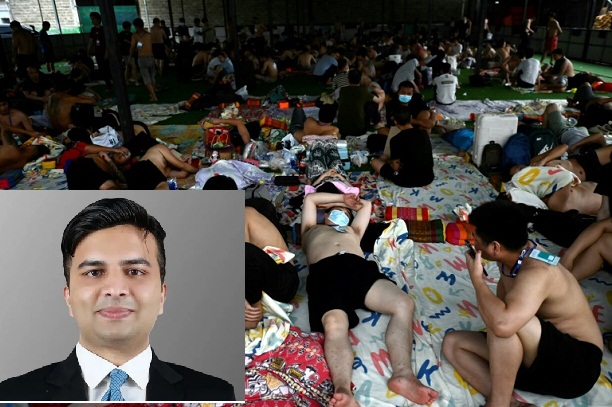
Saad Kassis-Mohamed, (inset) Chairman of the Human Rights Association, has now directly called on Myanmar authorities to dismantle the notorious scam compounds and immediately release all Ugandan nationals being held against their will.
Fresh horror has emerged from Southeast Asia after the Human Rights Association revealed shocking details of Ugandan nationals trapped inside brutal scam compounds in Myanmar, where victims are allegedly being beaten, tortured, forced into online fraud and held like prisoners inside heavily guarded criminal fortresses.
The disturbing revelations were released Thursday, May 14, 2026, by Saad Kassis-Mohamed, Chairman of the Human Rights Association, who has now directly called on Myanmar authorities to dismantle the notorious scam compounds and immediately release all Ugandan nationals being held against their will.
In a strongly worded statement issued from Cape Town, the HRA accused authorities in Myanmar of allowing a vast criminal network to flourish along the Thailand-Myanmar border while hundreds of desperate victims remain trapped in forced labour operations run by organised criminal syndicates.
“The responsibility for the continued operation of these compounds and for the suffering of Ugandan nationals held within them rests entirely with Myanmar,” the HRA declared.
The human rights body says Ugandans are among thousands of victims lured into Southeast Asia with fake promises of lucrative office jobs, only to find themselves trafficked across the Thai-Myanmar border into massive industrial scam compounds where escape is nearly impossible.
According to the HRA, the recruitment pattern is almost always the same.
Victims receive attractive offers for jobs in Thailand or other parts of Southeast Asia through social media platforms and messaging apps. Believing they are travelling for legitimate employment opportunities, they accept the offers and board flights filled with hope for a better future.
But instead of office desks and salaries, they allegedly arrive in a nightmare.
Once they reach the Thai-Myanmar border, they are secretly transported into Myanmar and locked inside giant scam compounds guarded by armed men, surveillance systems and heavily controlled perimeters.
Inside the compounds, victims are allegedly forced to work in large-scale online fraud schemes under nonstop surveillance and violent coercion.
The HRA says anyone who refuses to participate, fails to meet targets or attempts escape faces severe punishment, including beatings, torture and even being sold to other criminal operations.
One of the survivors identified in the report is a Ugandan man known as Small Q.
According to the HRA, Small Q travelled to Southeast Asia believing he had secured a data entry job in Thailand. Instead, he was trafficked into the Tai Chang scam compound in Myanmar, a gigantic 500-acre facility reportedly linked by the United States Department of Justice to a local militia group and Chinese organised crime networks.
Inside the compound, Small Q was allegedly forced to work shifts lasting up to eighteen hours a day while being handed 400 telephone numbers daily and ordered to meet strict engagement quotas.
The survivor described the horrifying physical and psychological pressure he endured during captivity.
“He described the physical and psychological coercion he endured as making his mind go dark,” the HRA revealed.
After surviving the ordeal, Small Q eventually managed to escape and return to Uganda.
Another Ugandan victim identified only as Joseph, a journalist by profession, was reportedly told he would work as a customer service agent for a supermarket in Southeast Asia.
Instead, Joseph was allegedly trafficked into another scam compound where he too was forced into online fraud operations.
But unlike many victims who remained silent in fear, Joseph secretly began recording video testimony from inside the compound using his phone in a desperate attempt to expose the conditions and alert the outside world.
The videos reportedly documented the terrifying environment inside the compounds where victims were allegedly trapped and controlled by criminal gangs.
After escaping, Joseph and several other Ugandan nationals reportedly found themselves abandoned without money, food or official support, forcing them to sleep on the streets before eventually finding shared accommodation.
“These cases are not exceptional,” the HRA warned.
The organisation pointed to findings by Amnesty International, which documented Ugandan nationals among survivors interviewed following mass escapes from scam compounds in January 2026.
According to estimates by the United Nations, nearly 120,000 people remain trapped inside forced scam labour operations in Myanmar alone.
The HRA says the scam compounds are not small hidden hideouts but enormous fortified industrial complexes stretching across hundreds of acres and protected by armed guards and sophisticated surveillance systems.
“The scam compounds at the centre of these operations are not makeshift facilities,” the HRA said. “They are fortified industrial complexes, some in excess of 500 acres in size, surrounded by armed guards, surveillance systems, and controlled perimeters from which independent escape is effectively impossible.”
The human rights body warned that the criminal syndicates behind the compounds continue operating freely because their leaders have not been arrested or prosecuted.
“Without their arrest, prosecution, and asset seizure, the compounds will continue to operate, and Ugandan nationals will continue to be recruited into them,” the statement warned.
Chairman Saad Kassis-Mohamed delivered some of the strongest remarks in the report as he directly blamed Myanmar authorities for allowing the system to continue.
“Small Q was promised a desk job in Thailand. He ended up in a 500-acre fortress in Myanmar, working eighteen-hour shifts under threat of violence, given 400 numbers a day and told to meet his quota or face the consequences,” Kassis-Mohamed said.
“Joseph filmed what was happening on his phone because he knew that if the world did not see it, nothing would change. These are Ugandan men who did nothing wrong except trust an employment offer.”
He added: “The responsibility for what happened to them sits with Myanmar. The authorities there have an obligation under international law to dismantle these compounds, release every Ugandan national held against their will, and ensure that the criminal syndicates running these operations face justice. That obligation is not contingent on political will. It is a matter of law.”
The HRA is now demanding immediate action from Myanmar authorities, including dismantling all scam compounds operating within the country, releasing all Ugandan nationals trapped inside them and prioritising those who have formally requested repatriation assistance.
The organisation also wants criminal syndicate leaders arrested and prosecuted through international judicial cooperation while their assets are seized and forfeited.
In addition, the HRA is urging Myanmar authorities to cooperate fully with the Government of Uganda in rescuing and repatriating all remaining Ugandan victims trapped inside the compounds.
The Human Rights Association, an initiative of the WeCare Foundation, says it continues working across Africa, South Asia and the Gulf region to defend victims facing unjust detention, denial of medical care and due process violations.
But as more Ugandan victims continue emerging with chilling stories from Myanmar’s scam compounds, pressure is now mounting for urgent international intervention before more young Ugandans disappear into what survivors are calling modern-day slavery camps hidden deep inside Southeast Asia.
As pressure mounts, Uganda’s envoy to Malaysia Ambassador Bigombe says the Ugandan government has continued engaging regional authorities and captors to facilitate rescues and repatriation missions.
“Many Ugandans are lured to work in Myanmar’s online scam centres, where they end up suffering. Many agents are operating in Uganda, and almost every day, Ugandans fall victim,” Bigombe warns.
Government rescue operations have already returned several victims home over the past two years.
In May 2024, twenty-three Ugandans were rescued and returned home. In March 2025, six Ugandans were repatriated after surviving a horrifying thirteen-month ordeal. In April 2025, eighteen Ugandans were received by Ugandan embassy officials after being rescued from scam centres. On May 19, 2025, another twenty-six Ugandans, thirteen men and thirteen women, were successfully repatriated after months of coordination.
But despite those efforts, officials say the crisis is far from over.
Reports now suggest at least twenty-seven Ugandans remain trapped inside Myanmar scam compounds as of May 2026, desperately appealing for rescue and repatriation support.
Uganda’s High Commission in Kuala Lumpur together with Uganda’s Embassy to Thailand have reportedly been working closely with local authorities and organisations such as Hope Cry International to facilitate rescues and evacuations.
But as more survivors continue emerging with chilling accounts of torture camps, forced cybercrime and modern-day slavery, pressure is rapidly building on Myanmar authorities and international agencies to act before more Ugandans vanish into what survivors are calling “scam factories” hidden deep inside the lawless border regions of Southeast Asia.
About Post Author