ATU And ICT Ministers Underscore The Importance Of the Digital Economy For Africa’s Resilient Growth
By Fab Mc
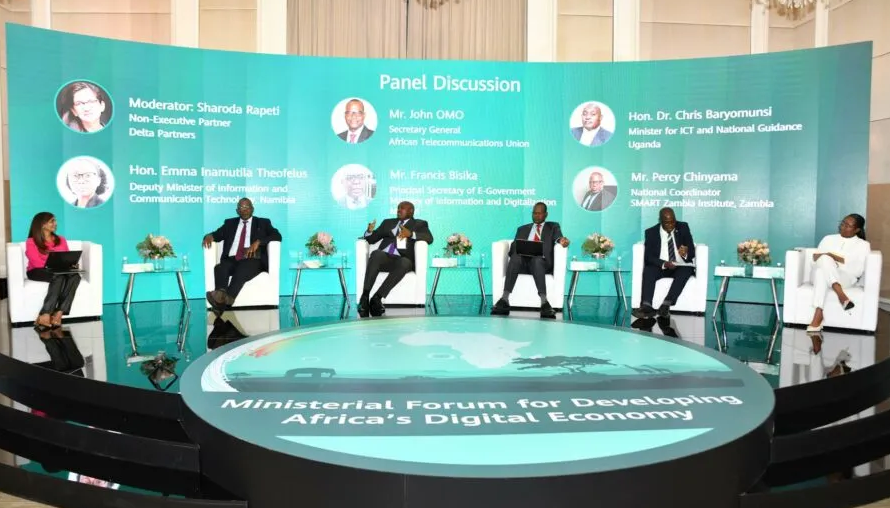
The African Telecommunications Union (ATU) held a ministerial forum on Day 0 of AfricaCom 2022, bringing together participants from Malawi, Namibia, Uganda, and Zambia. The session focused on methods to engineer a new sense of hope for Africa’s digital economy journey.
Under the theme ‘Rise Stronger with the Digital Economy: New Paths towards a Resilient Recovery and Growth’, the forum was supported by Huawei.
Introducing the session, the General Secretary of the ATU, John Omo spoke about digital transformation as the driver of inclusive economic growth, job creation, the improvement of public service delivery, and the optimization of business services in Africa.
“Africa needs digital innovation to spill over into all segments of business and society if we are to strengthen our digital economy,” he said. “According to the World Bank, Africa requires US$100 trillion to achieve full digital transformation, and no one, in the public or private sector, has the capacity to do this alone. Through the power of investment and of regulation, together we can craft a framework that will give effect to the growth and development we want to see.”
Leo Chen, Huawei President of the Sub-Saharan Africa Region, in his address, emphasized the three major elements of digital transformation: digital infrastructure, digital services, and digital skills.
“If we do these three things well, we can connect the unconnected people and businesses, fully unleash digital productivity, and develop the digital economy, no matter what its definition is,” he said.
Chen explained that Huawei innovates to find local solutions to local problems with local partners. “We are a leading global ICT company, and technology is our most significant asset. We want to keep what matters most in Africa. That is why we have made significant investments in people and skills transfer, through training, certification, and joint innovation.”
Forum guests were in consensus that digital infrastructure is fundamental to ensuring the digital transformation of their respective countries. In Malawi, according to Francis Bisika, Principal Secretary of e-Government, 230 000 km of fiber network has been installed across the country including in remote rural areas.
“We are addressing the issue of connectivity, especially in rural areas. We are also bringing fiber to the home, as well as to businesses. Once we have connectivity, we can address the issue of digital literacy,” he said. “We have also built a government data center in which we are accommodating businesses and individuals’ requests for networking and storage, making ICT facilities available to as many Malawians as possible.”
All of the guests have one thing in common: the integration of all government ministries, departments, and agencies. This is for example in issues around agriculture and education – technology is being incorporated into their systems.
“The digital sector has been given authority in Zambia,” said Zambia’s National Coordinator of SMART Zambia Institute, Percy Chinyama “We are working to maximize the work of revenue-generating departments and to reduce duplication of work and now have 240 government services online.”
ICT and climate change share equal importance in Namibia, according to Emma Theofelus, Deputy Minister of Information and Communication Technology. “Digitisation and energy efficiency go hand in hand,” she said, “and we are committed to working to increase levels of digitization and reducing our impact on climate change.”
Another theme was that of the inclusion of youth in the continent’s digital transformation. Given that 60% of Africa’s population is under 25, harnessing and retaining the innovation of its young people is critical for the future of Africa.
“Even as we have increased the number of tertiary education institutions, levels of unemployment remain a problem, and so we are working towards increasing job creation for graduates,” said Ugandan Minister for ICT and National Guidance, Chris Baryomunsi.
The forum closed with the signature of a joint communique where all participants agreed that the development of the digital economy is measurable. In order to develop the digital economy, countries need to have in place a top-level strategy and an implementation roadmap, with clear objectives, indicators, and milestones. They also require favorable policies to encourage investment, improve efficiency, and enable the infrastructure, skills, information environment, and innovation needed to grow the digital economy. This will create a fair business environment for all investors.
About Post Author